
| Image:Facebook |
The dispute between actor Taye Arimoro, producer Peggy Ovire, and three major Nollywood guilds has rapidly grown from a minor on-set misunderstanding into one of the industry’s most contentious battles in recent years.
What began on an ordinary filming day for the romantic drama Pieces of Love has now escalated into a national conversation about power, due process, and the limits of guild authority in Nollywood.
Arimoro’s decision to go public with allegations of physical assault triggered a chain of events that exposed deep fractures within the industry’s governance structure.
The controversy first erupted on October 12 when Arimoro livestreamed from the film set accusing Ovire, who doubled as producer and co-star, of physically assaulting him.
The video immediately circulated online, fueling outrage and speculation. Matters intensified when CCTV footage from the estate where the shoot was taking place surfaced hours later, prompting online debates over who initiated the conflict and whether Arimoro’s livestream accurately represented the confrontation.
For many viewers, the footage raised more questions than answers and positioned the event as a bigger issue about how power is exercised on Nollywood sets.
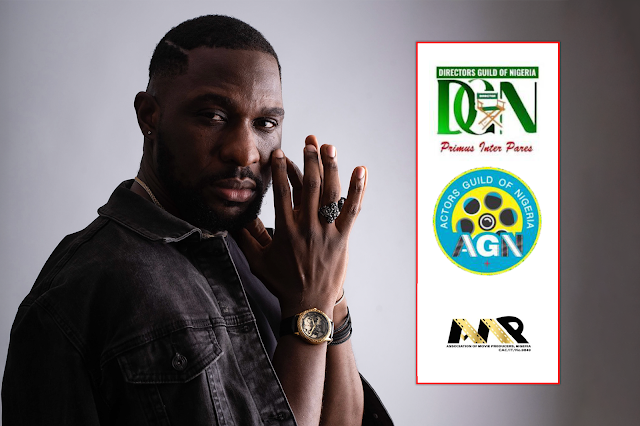
The situation reached a boiling point on November 28 when three of Nollywood’s most powerful guilds—the Actors Guild of Nigeria (AGN), Directors Guild of Nigeria (DGN), and the Association of Movie Producers (AMP)—released a joint disciplinary statement.
The guilds repeatedly misspelled Arimoro’s name as “Taiye Ayimoro,” a detail that quickly drew public criticism but did not prevent the document from taking force.
The statement declared Arimoro the primary aggressor, accused him of assaulting crew members, and described his livestream as misleading and damaging to Peggy Ovire’s reputation.
The guilds imposed sweeping sanctions, including an indefinite suspension from all Nollywood productions, a mandatory public apology, a corrective video, and a directive requiring him to return to set to complete pending scenes under strict supervision.
Peggy Ovire did not escape scrutiny entirely, though the guilds largely cleared her of initiating the conflict. They reprimanded her for following Arimoro to the estate gate and escalating the situation.
She was instructed to issue multiple written apologies and sign undertakings to improve personnel management on future productions. But the weight of the sanctions fell overwhelmingly on Arimoro, setting the stage for a legal confrontation.
On December 3, Arimoro’s legal team issued a detailed and forceful rebuttal that rejected the guilds’ findings in their entirety.
The response questioned the legitimacy, legality, and jurisdiction of the guilds’ actions, arguing that Arimoro is not a registered member of AGN, DGN, or AMP and therefore cannot lawfully be summoned, investigated, sanctioned, or banned by them. His lawyers described the misspelling of his name as a “fundamental error” that undermined the validity of the entire process.
They further argued that Arimoro was never granted fair hearing, claiming he was invited only for a fact-finding session and never informed of any disciplinary proceedings.
The legal statement went on to assert that AMP never contacted him at any point, yet fully participated in imposing sanctions.
It also claimed that the guilds’ directive warning Nollywood practitioners not to work with him violates his constitutional rights, including freedom of association under Section 40 and protections guaranteed by the African Charter on Human and Peoples’ Rights.
His lawyers described the sanctions as malicious attempts to sabotage his career, damage his reputation, and cause financial harm.
Arimoro’s team issued a 24-hour ultimatum demanding a full retraction of the guilds’ statement and a public apology, threatening a ₦1 billion lawsuit if the guilds failed to comply.
With the sanctions still publicly available and both sides standing firm, the industry now watches closely as the conflict shifts from social media and guild chambers to what may become a landmark legal battle.
This clash has sparked broader conversations across Nollywood, with several actors openly supporting Arimoro and criticizing opaque disciplinary structures they believe are used to intimidate and silence creatives.
The eventual outcome may redefine the balance of power between actors, producers, and guilds, and could shape the future of Nollywood’s labour and governance systems for years to come.
#ExcluisveUpdate
#ViralContent




Leave a Reply