
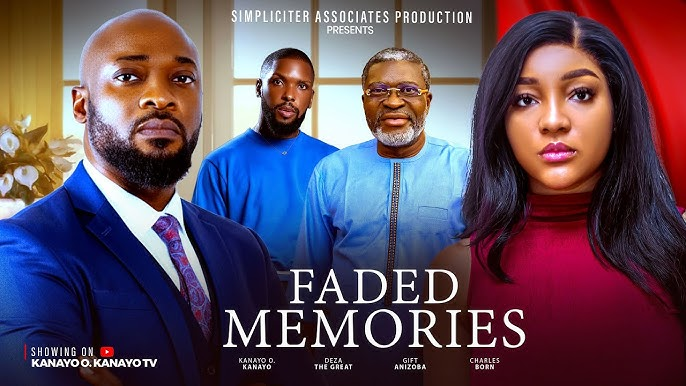
Introduction: The Nostalgia and the Narrative Hook
Nollywood veteran Kanayo O. Kanayo (KOK) is back in FADED MEMORIES (2025), a drama that attempts to fuse the classic amnesia trope with deep familial trauma, all packaged within a story that initially promises a quick path to “generational wealth.” The film, co-starring Deza the Great and Charles Born, stretches over two hours, demanding significant investment from the viewer. It’s a cinematic experience that constantly battles itself: pitting the calculated, almost cynical plotting of its opening against the genuinely moving emotional core it stumbles upon in its final act. The question isn’t just whether it delivers on its drama, but whether it sacrifices too much logic to get there.
FADED MEMORIES sets the stage with the introduction of Sunshine, a beautiful young woman suffering from retrograde amnesia after a car accident. She serves as the ultimate catalyst, landing in the orbit of two brothers, Ana and Jamal. Jamal, the pragmatic and hilarious opportunist, instantly spots an “investment” opportunity, convinced that the beautiful, well-spoken patient must belong to an affluent family, setting off a chain of events rooted in pure, materialistic greed. This engineered conflict provides the film’s initial, and highly engaging, hook.
I. Narrative and Screenplay Critique: The Price of the Trope
The film’s most critical structural decision is its reliance on the amnesia trope. While the script mentions terms like “retrograde amnesia” and uses the doctor to explain the condition, it swiftly treats the malady as little more than a narrative blank slate. Sunshine is vulnerable, but conveniently functional and emotionally present, allowing her to immediately begin changing the lives of those around her. This lack of medical realism is typical of Nollywood melodrama, prioritizing emotional impact over clinical accuracy.
The pacing of the two-hour runtime is uneven. The initial segment focusing on Jamal’s manic schemes and Ana’s reluctant acceptance is witty and fast-paced (01:23:44), driven by a surprisingly sharp comedic dialogue. However, the film slows considerably during the middle segment, settling into a pattern of domesticity (01:17:16 – 01:25:00) that, while necessary for developing the central romance, occasionally drags. The film finally finds its second wind in the last 40 minutes, where the two major plot twists are revealed with rapid succession, feeling almost rushed after the meandering middle.
The subplot integration is where the screenplay shows its most pronounced flaws. The “Generational Wealth” plot, championed by Jamal, is effectively extinguished with the trip to the village (00:58:30). The revelation that Sunshine’s memory only recalled her humble home crushes the materialist dream instantly, leaving Jamal to become pure comic relief for the rest of the film. While this subversion is thematically strong (emphasizing that the real wealth was the love found), it leaves Jamal’s character directionless.
Conversely, Ana’s decades-long family conflict with his father (Chief KOK) is initially heavy-handed. Ana’s anger feels justified from his perspective (the belief that his father neglected his mother), but the ultimate reveal—that his father stayed with his mother despite her having an affair and raising another man’s child (01:39:13)—is monumental. It is a powerful, shocking reversal that justifies the final, emotional reconciliation (01:50:29). The script’s coherence is tested here; the resolution is emotionally earned, but structurally relies on an enormous secret being kept for over twenty years, straining believability.
II. Character Development and Acting Performance: The Heart and the Hustler
Ana (Protagonist): The emotional center of the film is Ana, whose transformation is the story’s ultimate point. He starts cynical, driven by a pragmatic acceptance of Jamal’s ‘get-rich-quick’ scheme. His care for Sunshine, however, is organic, seen in small, tender moments like buying her a book or standing up for her (02:18:52). His character arc from reluctant host to devoted fiancé and, finally, the broken, forgiving son is commendably played by the lead actor, who manages to ground the melodrama in authentic anguish, particularly when he confesses his deep regret to Sunshine (01:41:08).
Jamal (Antagonist/Comic Relief): Jamal, played by Deza the Great, is the film’s most memorable and chaotic element. His performance is a masterclass in Nollywood comic delivery, with his non-stop energy, exaggerated reactions, and hilarious use of Nigerian slang. The infamous “Enemy of progress!” line (01:41:13) perfectly encapsulates his greedy motivation. However, his abrupt demotion from main antagonist to a noisy sidekick after the village trip weakens the plot. He remains entertaining, but his character stops developing.
Sunshine (The Catalyst): As the catalyst, the actress successfully conveys a quiet vulnerability. She’s not a passive victim; she has an internal spark that attracts Ana and enables her to offer profound advice, particularly the moving monologue that encourages Ana to forgive his father: “It is his first time here on earth” (01:22:18).
Chemistry: The romantic chemistry between Ana and Sunshine is gradual and genuine, evolving from pity to respect to deep love. The film builds this connection effectively through shared domestic moments rather than forced dramatic scenes. The brotherly dynamic between Ana and Jamal is equally compelling—a perfect mix of exasperation and deep-seated affection, especially highlighted in their final, affirming scene (01:32:03).
III. Thematic Depth and Messaging: The Real Investment
FADED MEMORIES excels in its thematic ambition, which lifts the narrative above its structural weaknesses.
The Burden of Past Secrets: The most powerful theme is the destructive nature of miscommunication and secrets. Chief KOK’s willingness to endure his son’s hatred and go to his grave without clearing his name (01:41:36) highlights a tragic, archaic form of selfless parental love. The resolution emphasizes that true love requires grace and the willingness to look past perceived slights.
Love vs. Materialism: This is the film’s central moral battle. Jamal represents crass materialism; he sees people as commodities. Ana, in contrast, learns that the real investment is time, compassion, and emotional honesty. The crushing blow of Sunshine’s poverty is ironically the moment Ana realizes the value of their connection transcends wealth, leading to the heartfelt, unscripted proposal (01:53:36).
Social Class Commentary: The use of the memory trip to a humble dwelling as a major plot twist is a fantastic moment of subversion. It deconstructs the conventional Nollywood expectation of a wealthy savior, forcing the characters (and the audience) to confront the prejudice embedded in the initial premise. It’s a powerful statement that validates love and integrity over assumed pedigree.
IV. Technical and Cinematic Execution: The Nollywood Standard
The directing and cinematography in FADED MEMORIES are generally professional, adhering to the high production values expected of modern Nollywood. The use of the mansion settings is conventional, but the lighting is mostly crisp, particularly during the intimate domestic scenes. The outdoor running scenes, used to symbolize Ana and Sunshine’s health and growing bond, are well-shot (01:38:08).
Sound and Editing maintain a decent standard. Dialogue clarity is consistent, avoiding the sound mixing issues that plague older films. The editing flows smoothly, though certain dramatic close-ups of Jamal’s reactions are held for too long for comedic effect, momentarily pulling the viewer out of the primary drama. The use of a recurring sentimental love song effectively cues the audience to key romantic developments, culminating in the proposal scene.
Production Design is standard but effective. The contrast between the Chief’s luxurious home and the simplicity of Sunshine’s recalled village dwelling is sharp and deliberate. Costumes and makeup are appropriate, with the characters consistently looking polished, even during emotional distress. Kanayo O. Kanayo’s portrayal of the quiet, suffering patriarch is dignified and impactful.
Conclusion: A Flawed Gem Worth the Investment
FADED MEMORIES is a film of stark contrasts. Its primary flaw lies in its structural inconsistency, notably in the abandonment of the “Generational Wealth” plot and the melodramatic reliance on the twenty-year-old family secret.
However, these flaws are overshadowed by the film’s high emotional return.The film’s highest merit is its powerful and earned thematic resolution. The reconciliation between Ana and his father, based not on a convenient lie but on a difficult, selfless truth, provides a genuinely moving climax.
The film successfully pivots from a story about getting rich to a story about being rich—rich in love, forgiveness, and family. It’s a messy, chaotic, and utterly human melodrama that delivers on heart, if not on logic.
Rating: 4 / 5 Stars
Recommendation: Worth a Watch. Come for Jamal’s antics, stay for the emotional gut-punch delivered by Kanayo O. Kanayo and the sincere, heartwarming romance.
Call-to-Watch: Have you ever misjudged someone you love? Click the link and let me know in the comments if you think Ana was right to wait so long to forgive his dad!
#NollywoodTimes
#FadedMemoriesReview
#KanayoOKanayo2025
#NollywoodAmnesia














Leave a Reply