
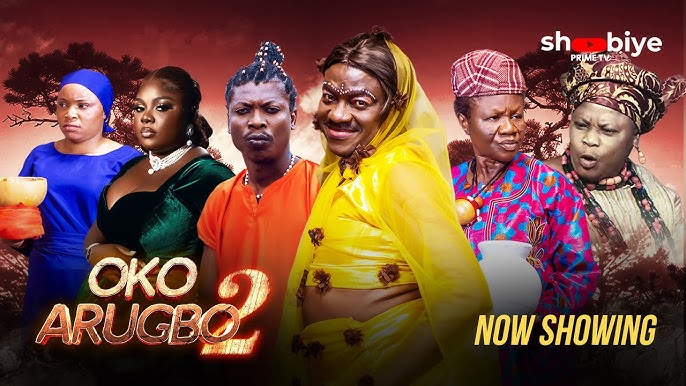
#OkoArugbo2 #YorubaMovies2026 #IyaGbonkan
#NollywoodReview
Overall Rating: ………………….. 3.5 /
5 Stars
The Hook: A Legacy of Dread and Drama
In the landscape of Yoruba cinema, few names command as much
immediate, visceral respect—and a hint of ancestral fear—as Iya Gbonkan.
When the credits roll on OKO ARUGBO 2, you aren’t just watching a movie;
you are stepping into a curated world where the veil between the physical and
spiritual is paper-thin.
Directed by Sanusi Iziahq, this sequel arrives at a time
when Nollywood is grappling with its identity: do we lean into the glossy,
high-budget “New Nollywood” aesthetic, or do we double down on the
raw, grassroots storytelling that made the industry a global phenomenon? OKO
ARUGBO 2 attempts to do both, blending the terrifying mysticism of
old-school Yoruba epics with the biting economic realities of 2026 Nigeria.
Cinematography: Bridging the Gap Between TV and Cinema
One of the most striking elements of OKO ARUGBO 2 is
the visual upgrade from its predecessor. The camera work, handled with a keen
eye for framing, moves away from the static “talking head” shots that
often plague low-budget productions.
- Framing
and Shot Variety: The director makes excellent use of Dutch angles and
tight close-ups during the spiritual confrontations (notably around the
10-minute mark). These shots successfully mirror the internal
disorientation of the characters. - Lighting
and Mood: Night scenes in Yoruba horror are notoriously difficult to
light without losing detail. Here, the production team uses high-contrast
lighting to accentuate the facial features of the antagonists,
particularly the legendary Abeni Agbon. However, some interior daytime
scenes still suffer from a “flat” TV-style look where the
natural sunlight overpowers the intended mood. - Color
Grading: There is a distinct shift in the color palette. Scenes
involving the “Old Ones” or spiritual elders are graded with
earthy, desaturated tones, while the “city” scenes are vibrant
and saturated, emphasizing the clash between tradition and modern
ambition.
Sound Design: The Pulse of the Supernatural
Sound is often the Achilles’ heel of Nollywood, but OKO
ARUGBO 2 treats its audio with uncharacteristic reverence.
The dialogue is remarkably crisp, even in exterior scenes
where Lagos or regional background noise usually interferes. The sound mixing
finds a delicate balance; when the “Eagles” are mentioned or appear,
the ambient sound drops out, replaced by a low-frequency hum that signals
impending doom.
The use of traditional Yoruba percussion is not just
background filler—it’s a narrative tool. The drums syncopate with the
characters’ heartbeats during the “death by motor accident”
sentencing, making the audience feel the weight of the curse. If there is a
flaw, it is the occasional “stock” sound effect used for transitions,
which can briefly break the immersion.
Costume, Makeup, and Production Design: Authenticity as a
Character
The production design in this film serves as a masterclass
in social coding.
- The
Spiritual Elder Look: The costuming for Iya Gbonkan and the elders is
impeccable. It doesn’t rely on “costume shop” clichés; instead,
the fabrics look aged and weathered, suggesting a lifetime of ritual and
history. - Modernity
vs. Tradition: The contrast between the characters discussing
“1.5 million Naira” and “minimum wage” and those
wearing ancestral regalia creates a jarring, effective visual
representation of modern Nigeria—a country with one foot in the digital
bank app and the other in the sacred grove. - Makeup
Realism: The SFX makeup for the spiritual manifestations is subtle
rather than “gory,” which works better for this genre. It relies
on the natural, expressive lines of the veteran actors’ faces rather than
heavy prosthetics.
Narrative Structure: Pacing the Pendulum
The story opens with an immediate hook—a display of power
that sets the stakes high. Unlike many Nollywood sequels that spend forty
minutes recapping the first film, OKO ARUGBO 2 assumes you’re ready for
the ride.
The film employs a non-linear spiritual logic. We see a
character pleading for mercy early on, followed by a descent into the
“why” and “how.” The pacing, however, does hit a snag in
the middle. The subplot regarding the “minimum wage” and financial
negotiations drags slightly, feeling like a separate movie about Nigerian
economics before it loops back into the supernatural climax.
Plot Logic and Thematic Depth: More Than Just
“Juju”
The film’s core theme is Accountability. While on the
surface it looks like a “juju” movie, it is actually a social
commentary on greed and the consequences of “cutting corners” in a
tough economy.
- The
Trope Flip: It uses the “sudden wealth” trope but examines
it through the lens of a debt that must be paid to the ancestors, not just
a bank. - The
1 Billion Naira Question: The mention of 1 billion Naira serves as a
metaphor for the astronomical corruption and ambition currently permeating
society. The film asks: What is the spiritual exchange rate for such
wealth? - Logic
Gaps: There are moments where character motivations feel
rushed—specifically, why a certain protagonist returns to a clearly cursed
location—but these are often smoothed over by the sheer charisma of the
cast.
Characterization: The Titans of the Screen
The performances are the heartbeat of OKO ARUGBO 2.
- The
Veterans: Iya Gbonkan and Abeni Agbon are, as expected,
terrifyingly good. They don’t need to scream to command a scene; a simple
glare is enough. Their delivery of the Yoruba language is poetic and deep,
reminding us of the richness of the culture’s oratory traditions. - The
Supporting Cast: Sanusi Iziahq and Malvins Tokunbo provide the
necessary “human” groundedness. Their code-switching between
Yoruba and English/Pidgin feels authentic to the modern Nigerian
experience. - Standout
Scene: The “Sentencing” scene at is a masterclass in acting.
The desperation in the victim’s voice contrasted with the cold, detached
authority of the judge creates a tension that is rarely achieved in home
video productions.
Cultural Relevance: A Mirror to the Nation
OKO ARUGBO 2 resonates because it speaks to the
“Nigerian Anxiety.” The constant mention of “minimum wage”
and “10 million” reflects a society obsessed with survival. The film
uses the spiritual realm as a “higher court” where the poor man can
finally see the arrogant “big man” face justice. It’s a cathartic
experience for the local audience and a fascinating cultural study for the
diaspora.
The Verdict: Is It Worth Your Data?
OKO ARUGBO 2 is a rare sequel that manages to expand
the lore of its world without losing its soul. It isn’t a perfect film—the
middle section could have used a tighter edit, and some subplots feel like they
belong in a different genre—but its strengths far outweigh its weaknesses.
The resolution, centered on the idea that “an eye for
an eye makes the world go blind”, provides an unexpectedly moralistic and
emotional payoff. It moves the film from a story of “revenge” to a
story of “redemption.”
Who Should Watch This?
My Verdict: WATCH IT. It is a haunting,
culturally rich, and ultimately thought-provoking piece of cinema that proves
the “old guards” of Nollywood still have plenty of fire left in them.
Summary Table: The Breakdown
|
Category |
Score |
Notes |
|
Acting |
4.5/5 |
Iya Gbonkan is a force of nature. |
|
Cinematography |
3.5/5 |
Great framing; lighting can be inconsistent. |
|
Story Originality |
3/5 |
Familiar tropes, but with fresh social commentary. |
|
Sound & Music |
4/5 |
Excellent use of traditional motifs and clear dialogue. |
|
Cultural Impact |
4.5/5 |
Deeply resonant with current Nigerian realities. |
Call-to-Action: Have you seen OKO ARUGBO 2 yet?
Does Iya Gbonkan still give you chills, or do you think the sequel lived up to
the hype? Drop a comment below and let’s discuss! Don’t forget to share
this review with your fellow movie buffs. Would you like me to analyze the
first part of this series to compare the character arcs?
#NollywoodTimes
#OkoArugbo2
#YorubaMovies2026
#IyaGbonkan
#NollywoodReview











Leave a Reply