
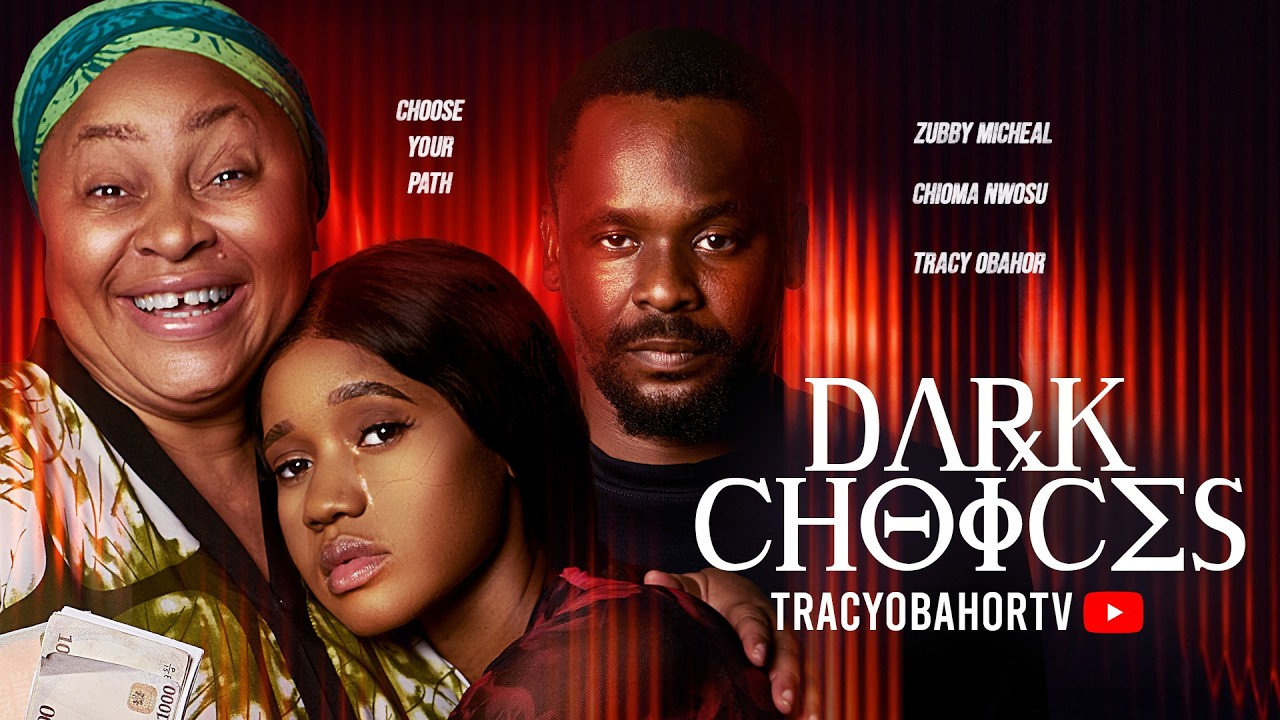
In the gritty underbelly of Nollywood’s 2026 lineup, Dark Choices drops like a reality check for every hustling Naija girl dreaming of escaping the village trap. Starring Zubby Michael as the suave contractor Richard, Chioma Nwosu as the conflicted beauty Ego, and comedy king Charles Inojie adding his signature spice, this Tracy Obahor-produced flick (full title: DARK CHOICES – ZUBBY MICHAEL, GEHGEH, CHIOMA NWOSU, CHARLES INOJIE, TRACY OBAHOR) hit YouTube on February 22, 2026, via TracyObahorTV.
Clocking nearly 2 hours, it’s a moral rollercoaster asking: Does poverty justify trading your soul for Birkins and Benz? No spoilers in this intro, but expect tears, laughs, and that classic Nollywood gut-punch. If you love Zubby Michael 2026 movies, Chioma Nwosu’s glow-up arcs, or latest Nollywood dramas tackling Naija hustle culture. Solid binge for a weekend.
The Narrative Architecture: A Mother’s Love or a Mother’s Greed?
At the heart of Dark Choices is a disturbing yet fascinating maternal dynamic. Tracy Obahor plays Ego, a girl whose only “crime” is being born into a poverty-stricken home with a face that looks like a million dollars. But the true engine of the plot is Ego’s mother (played with terrifying conviction).
The film explores the “Maternal Pimp” trope—a recurring theme in West African cinema where parents, blinded by their own failures, see their children as financial assets. The mother doesn’t just encourage Ego; she weaponizes her. She devalues Paul (the moral anchor), a humble teacher who offers love but no “credit alerts,” and pushes Ego toward the “Big Fish.”
Step-by-Step Scene Breakdown: The Rise and Hard Fall
Scene 1: The Bread and the Bible
The movie opens with Paul coming to ask for Ego’s hand. In a scene that is both hilarious and heartbreaking, Charles Inojie’s character mocks the “hot bread” Paul brings as a gift. It sets the tone: in this house, love is not a currency; bread is not enough. You need the “bakery.”
Scene 2: The “Pant” Lesson
One of the most talked-about scenes involves the mother advising Ego on how to handle Richard (Zubby Michael). She tells Ego to “be smart” and “not let him see your pants.” This is a raw, localized metaphor for maintaining mystery and “market value.” It’s a chilling look at how purity is commodified for a better life.
Scene 3: The 500k Revelation
When Ego returns with 500,000 Naira, the atmosphere shifts. The poverty that once suffocated the house is replaced by the high-pitched screams of joy. This scene is pivotal because it’s where Ego’s conscience officially dies. She realizes that her body can command more money in one afternoon than Paul can earn in a year.
Scene 4: The Mansion and the “Madam” Dreams
Enter Chief Magnus. The scene where Ego and her mother first enter the mansion is a masterclass in set design contrast. The bright, high-ceilinged rooms represent the “soft life” we all see on Instagram. Here, the dialogue about “Paris shopping” and “iPhone 17s” highlights the superficiality of their new existence.
Scene 5: The UK Surprise (The Climax)
The turning point occurs when a woman walks into the mansion, not as a guest, but as the owner. The revelation that Chief Magnus is an “importer/exporter” of lies—and that his wife has been the one funding his “Chief” persona from the UK—is the ultimate Nollywood “juju” moment.
Detailed Character Analysis
Ego: The Tragic Archetype
Ego isn’t a villain; she’s a vessel. Throughout the film, we see her internal struggle. She truly loves Richard, and she once cared for Paul, but she is a victim of Socio-Economic Gaslighting. By the end, she is a “healed” woman, but the scars of her choices mean she has to start from zero.
Zubby Michael as Richard: The Nuanced Contractor
Zubby Michael brings a surprising level of vulnerability to Richard. Usually known for playing the “strong man,” here he is a man who genuinely wants to marry Ego. His heartbreak when he realizes she chose a “bigger fish” is palpable. It’s one of Zubby’s most grounded performances in recent years.
Chief Magnus: The False Idol
The Chief represents the “Instagram Billionaire.” He is all swagger, point-and-kill pepper soup, and empty promises. He is the personification of the film’s title—a “Dark Choice” that looks bright from the outside.
Paul: The CEO of Persistence
Paul is the moral compass. While the world laughed at his “lesson teacher” status, his transition to a CEO of a POS stand (a very realistic Nigerian success story) proves that slow and steady growth outlasts “blood money” or fraudulent wealth.
Socio-Political Subtext: Beauty as Currency
Dark Choices asks a haunting question: In a country with 133 million people in multidimensional poverty, is it “evil” to want a way out?
The film critiques the “Get Rich Quick” culture but also sympathizes with the desperation that fuels it. It highlights how the “New Money” class in Nigeria is often built on a foundation of sand. The moment Chief Magnus’s wife arrives, we see that the “Soft Life” was just a rental.
Technical Review: Pacing and Production
The 1-hour 57-minute runtime is well-utilized, though the first act feels slightly repetitive with the mother’s constant shouting. However, the Cinematic Contrast is excellent. The grainy, crowded shots of the village shop compared to the wide-angle, sterile luxury of the mansion perfectly illustrates the psychological gap between the two worlds.
The Soundtrack: The recurring theme song about “hunger” and “mama’s voice” serves as a haunting Greek chorus, reminding the viewer that even in the mansion, the ghost of poverty is still lurking.
Pros and Cons
Pros:
• Performance: Charles Inojie provides the perfect comedic relief to a very heavy story.
• Realism: The transition of Paul from teacher to POS CEO is a brilliant, grounded touch.
• Dialogue: The Pidgin English used is sharp, witty, and culturally resonant.
Cons:
• Pacing: The middle section drags slightly during the “shopping montages.”
• The Mother’s Redemption: Some may feel the mother didn’t face a harsh enough consequence compared to Ego’s lost years.
TheVerdict: 8.5/10
Dark Choices is a masterpiece of modern Nollywood storytelling. It doesn’t just tell you that greed is bad; it shows you the agonizing process of how a good person is “cooked” into a greedy one by their environment.
• Screenplay Originality: 8/10
• Acting Quality: 9/10
• Cultural Relevance: 10/10
Should You Watch It?
If you are looking for a movie that will spark a 3-hour debate in the comment section or with your family, “Dark Choices” is it. It is a cautionary tale for the “Slay Queen” era and a reminder that not everything that glitters is a Chief’s gold—sometimes, it’s just a borrowed light that’s about to be turned off.
Call to Action: Don’t wait for the clips to spoil it for you on TikTok! Head over to YouTube and watch the full movie on TracyObahorTV. Watch it, then come back here and tell me: Who was the real villain? The Chief, the Mother, or the Poverty?
Watch DARK CHOICES on YouTube below!
#NollywoodTimes
#DarkChoicesReview
#Nollywood2026












Leave a Reply