
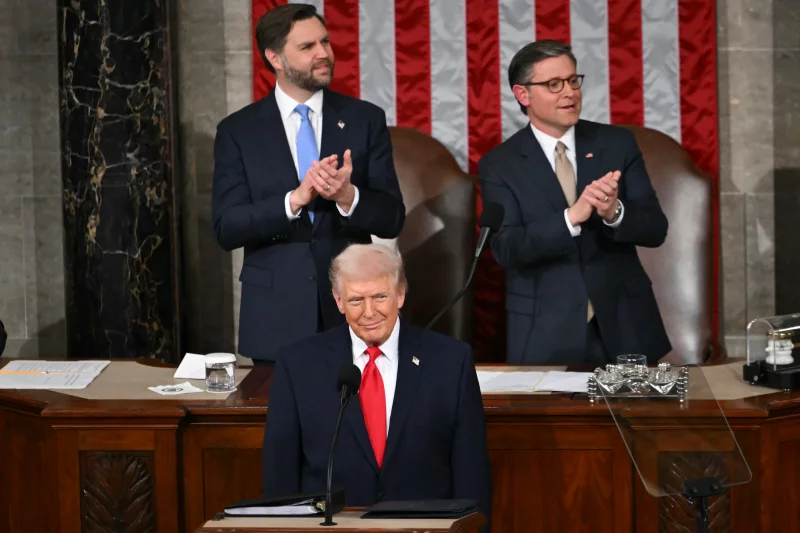
U.S. President, Donald Trump used his State of the Union address on Tuesday to present his case for possible military action against Iran, declaring that he would not allow what he described as the world’s leading sponsor of terrorism to obtain a nuclear weapon.
Speaking before a joint session of Congress at the U.S. Capitol, Trump accused Tehran of fueling regional instability through support for militant groups, suppressing domestic protests, and advancing its missile and nuclear programs.
“The regime and its murderous proxies have spread nothing but terrorism and death and hate,” Trump said roughly midway through his speech.
The address came amid a significant buildup of U.S. military assets in the Middle East, heightening speculation about a potential confrontation with the Islamic Republic. While the administration has increased pressure on Tehran, the president has offered limited public explanation about the scope or timing of any possible action.
Trump alleged that Iran has resumed efforts tied to its nuclear program and is developing missiles that could eventually reach the United States. He also blamed Tehran for roadside bombings that killed American service members and civilians in past conflicts.
🚨BREAKING: 🇺🇸President Trump in the State of the Union:
🇮🇷”In a decisive, breakthrough strike last June Operation Midnight Hammer—the United States military completely obliterated Iran’s nuclear weapons program right on Iranian soil.
Gone. Wiped out. For decades, we’ve said… pic.twitter.com/dLcozYTTS1
— SilcoHQ (@XYasii) February 25, 2026
Iran has consistently maintained that its nuclear activities are intended solely for civilian energy purposes.
The president said negotiations had stalled because Iran had not explicitly pledged to forgo nuclear weapons. “They want to make a deal, but we haven’t heard those secret words: ‘We will never have a nuclear weapon,’” he told lawmakers.
In response, Iran’s foreign ministry spokesperson rejected Trump’s assertions, calling them unfounded and accusing Washington of repeating what he described as longstanding false claims about Tehran’s nuclear ambitions and internal unrest.
Ahead of the speech, Secretary of State Marco Rubio briefed the congressional “Gang of Eight” senior leaders and intelligence committee heads on developments related to Iran.
Democratic leaders urged greater transparency. Senate Majority Leader Chuck Schumer said any decision involving military action should be publicly debated rather than handled in secrecy, warning that undisclosed operations risk prolonged conflict and unintended consequences.
Although Trump devoted most of his nearly two-hour address to domestic issues such as the economy and immigration, his remarks on Iran stood out against the backdrop of growing regional tensions.
The president, who has long campaigned on an “America First” platform and pledged to end so-called “forever wars,” faces a public that remains cautious about new overseas conflicts. Recent opinion polls show broad support for limiting military action to situations involving direct and imminent threats to U.S. security.
Trump reiterated that he prefers diplomacy but insisted he would act if necessary.
“As president, I will make peace wherever I can,” he said. “But I will never hesitate to confront threats to America wherever we must.”
#Trump #outlines #rationale #Potential #Iran #strike #State #Union #address







Leave a Reply