
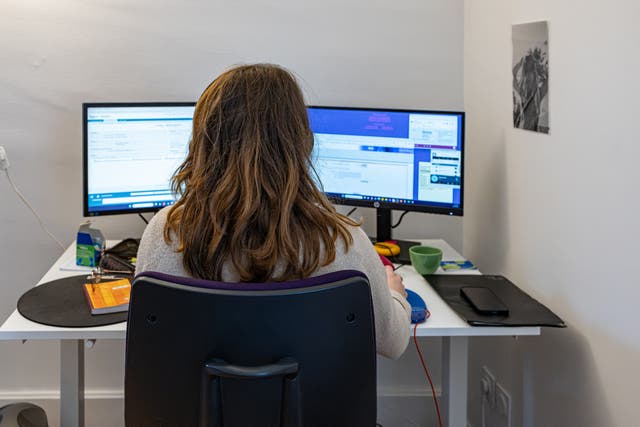
A United Kingdom tribunal has ruled that employees with agoraphobia – a fear of being unable to escape – can sue their bosses if they are not allowed to work from home.
Telling workers with the anxiety disorders they must work in the office can amount to disability discrimination under UK employment law, according to the judgment.
The landmark decision comes after Marina Dudding, a long-serving council housing officer with agoraphobia, was prohibited from working remotely two days a week upon her return from sick leave.
Ms Dudding successfully sued Gravesham Borough Council in Kent for disability discrimination and unfair dismissal, and is now set to receive compensation.
London South Employment Tribunal heard that Ms Dudding worked for Gravesham Borough Council from September 2000, with her final role being as an allocations officer within its housing options service.
She worked 37 hours a week, and from 2021, following the Covid-19 pandemic, she worked two days a week from home.
The tribunal heard: “Due to her Generalized Anxiety Disorder and Moderate Depressive Episode, [Ms Dudding] experiences symptoms of agoraphobia, which makes it difficult for her to leave her home.
“When having to leave the house, [she] finds it very stressful and becomes anxious; she has palpitations and abdominal pain on her way out to her destination.”
At the tribunal, Ms Dudding’s lawyer set out why she prefers to work from home.
It was heard: “When working from the office, [Ms Dudding] is interrupted with the performance of her duties, as colleagues can come forward to interact with [her] to ask questions or raise concerns, which would add further stress and anxiety.
“Having to work from the office causes [her] to feel chest pain or rapid heart rate, nausea, hyperventilation, or trouble breathing.
“During her time in the office, [Ms Dudding] has found it increasingly difficult to concentrate due to the noisy environment.
“This distraction has contributed to a heightened level of anxiety, which can sometimes escalate to a point where [she] experiences anxiety attacks.
“This resulted in [her] often having to isolate in the restrooms for up to 15 minutes in an attempt to reduce her anxiety.
“In contrast, when working from home, [she] is able to focus in a quiet environment free from any distractions, and manage her stress, which in turn has a positive impact on her performance.”
The tribunal heard that Ms Dudding was on sick leave between March and July 2023, as she was not able to leave her home and “not physically able” to come into the office.
She said her time off was due to work-related stress, high blood pressure, and anxiety.
She returned to work on a phased basis but failed to attend an appraisal meeting in October 2023, leading to a disciplinary investigation as there was concerns about complaints she received over her telephone conduct.
The tribunal heard: “From 24 October 2023, the [council] imposed an office-only requirement on [Ms Dudding] by revoking her established hybrid working arrangement.
“This requirement remained in place thereafter and operated in practice as a continuing expectation that [she] attend the office daily, without any identified review mechanism or time limit.”
Ms Dudding emailed her managers saying that it was having a “severe negative impact” on her health.
A further investigation ensued, and she took sick leave in January 2024, before a final written warning was given in March.
She attempted to return to work in April 2024, but was told that her hybrid work would not be reinstated, and she became “upset”.
She had also requested a later start time of 11.30am due to her condition.
After further unsuccessful discussions about her hybrid working and start times, she was sacked.
Management decided that she needed in-office support and oversight that could not be achieved when working from home.
Ms Dudding brought the case to the tribunal and won two disability discrimination claims, one indirect disability discrimination claim, and an unfair dismissal.
She is now in line for compensation.
Employment Judge Caoimhe O’Neill said: “The Tribunal finds that each impairment, namely GAD, MDE, and agoraphobia, had a substantial adverse effect on [Ms Dudding’s] ability to carry out normal day-to-day activities throughout the material period.
“[Gravesham Borough Council] knew, or in any event ought reasonably to have known, of [Ms Dudding’s] agoraphobia from May 2023 upon receipt of Occupational Health advice and [Ms Dudding] emails.
“From November 2023 onwards, [Ms Dudding] sent numerous emails to multiple managers explaining that the amended working pattern was severely worsening her morning functioning and overall health.
“Those communications provided a clear and contemporaneous audit trail of the difficulties she was experiencing.
“[Gravesham Borough Council] maintained repeatedly that, following the disciplinary process, in‑person oversight, daily office attendance, and early‑morning presence were operationally necessary for an employee returning from a live warning.
“That rationale was advanced in general terms, without reference to any characteristic personal to [Ms Dudding].
“Further, [Gravesham Borough Council’s] insistence upon office‑only working had no clear evidential foundation. Hybrid working remained available to other members of the team.”














Leave a Reply