
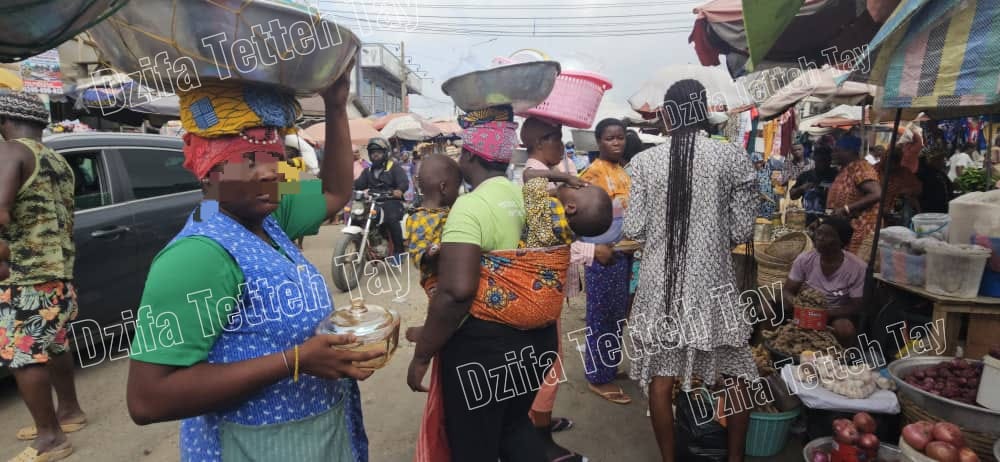
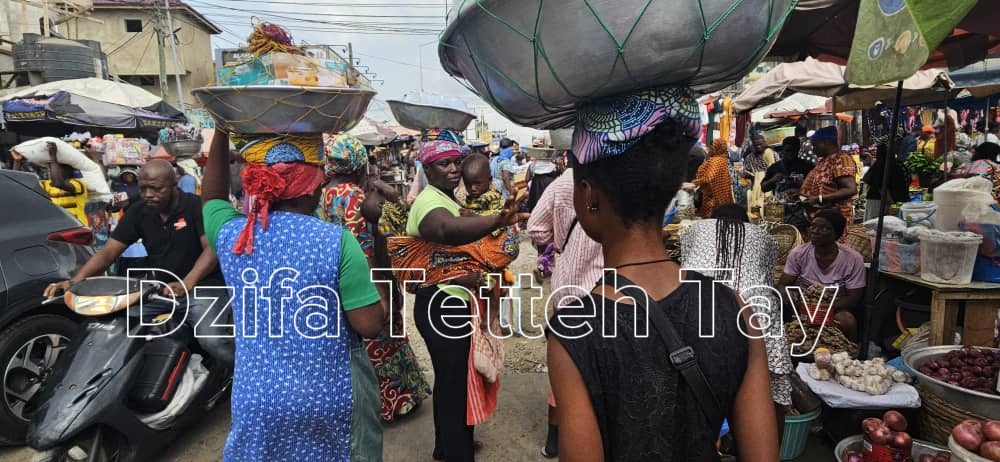
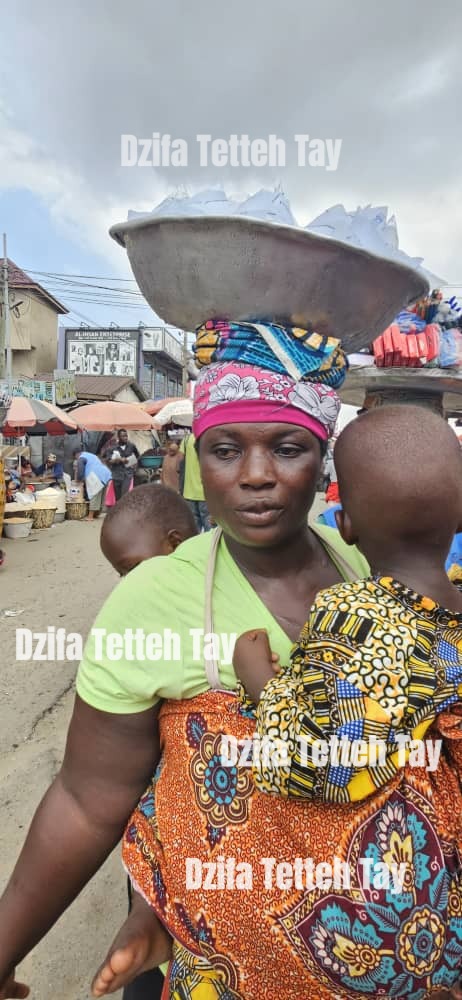
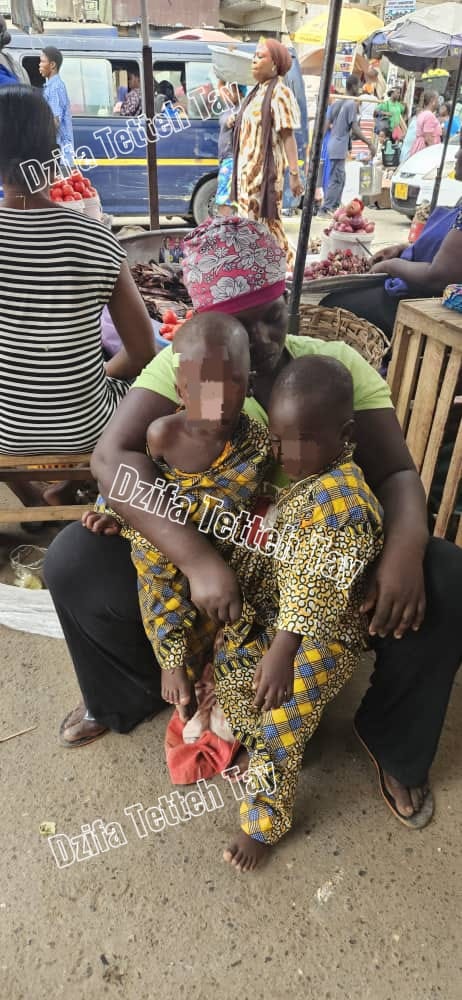
With a set of two three‑year‑old twins—one strapped to her back and the other secured on her front by two pieces of cloth fastened to prevent them from falling—Portia Quaye, a 28‑year‑old woman, balances a metallic basin filled with frozen sachet water on her head as she hawks on the streets of Nima.
She has been doing this since her children were as young as six months and, for the past two and a half years, in an attempt to make ends meet. This routine this reporter observed extended to Ashaiman, Kaneshie, Lapaz, and Kwame Nkrumah Circle streets, all in the Greater Accra Region.
The resident of Tema Newtown in the Tema Metropolis said although she was aware that frequently spending almost ten hours on the streets was dangerous—as vehicles and motorcycles jostled with pedestrians—and that the situation also had health implications for both her and her children, she had no choice but to continue to provide her children with basic necessities. She confirmed that her body often hurts badly because of the weight on her back, front, and head, and that people sometimes pushed them, which affected the children and even made them weak.
Ms Quaye said, for instance, her children had been sick for almost a month, so she could not go to the streets to sell and had just resumed work on Wednesday. She disclosed that during those moments, times had been hard. She said, when she noticed the children felt better, she decided to return to work.
Ms Quaye said she had tried to save some money to enroll the children in school, but she was compelled to spend them all when she couldn’t work.
The native of Komenda in the Central Region, said when the children cried, she felt disturbed and heartbroken, yet she seemed to have no choice. The hawker said she was therefore calling on the public to support her to enrol them in school and also raise some money to start a second‑hand clothing business, which she ran before pregnancy. She disclosed that she was married, but her husband’s support had been inconsistent, leaving her no option but to work under what could be described as harsh conditions to support the home.
She revealed that she made between ₵60 and ₵100 daily whenever she was able to go to the market. She added that because she did not own a refrigerator, she bought a bag of sachet water from shops that have already frozen it to start her business.
A tomato seller at the Nima Market, Mary Alornyeku, also added her voice to the call for support.
She said it was important for anyone who had the means to lighten her burden to do so as quickly as possible, as she feared for the safety of the children.
“We shouldn’t wait for something tragic to happen before we say we wish we had helped them,” she said.
Her sentiment was not different from that of Rukayatu Issah a Beans Seller who said the state of affairs was quite unacceptable and so government should intervene.
“Government should help this woman because she is suffering too much.” She said. END
#Balancing #Life #Livelihood #TwinToddler #Mothers #Struggle #Accras #Streets













Leave a Reply