
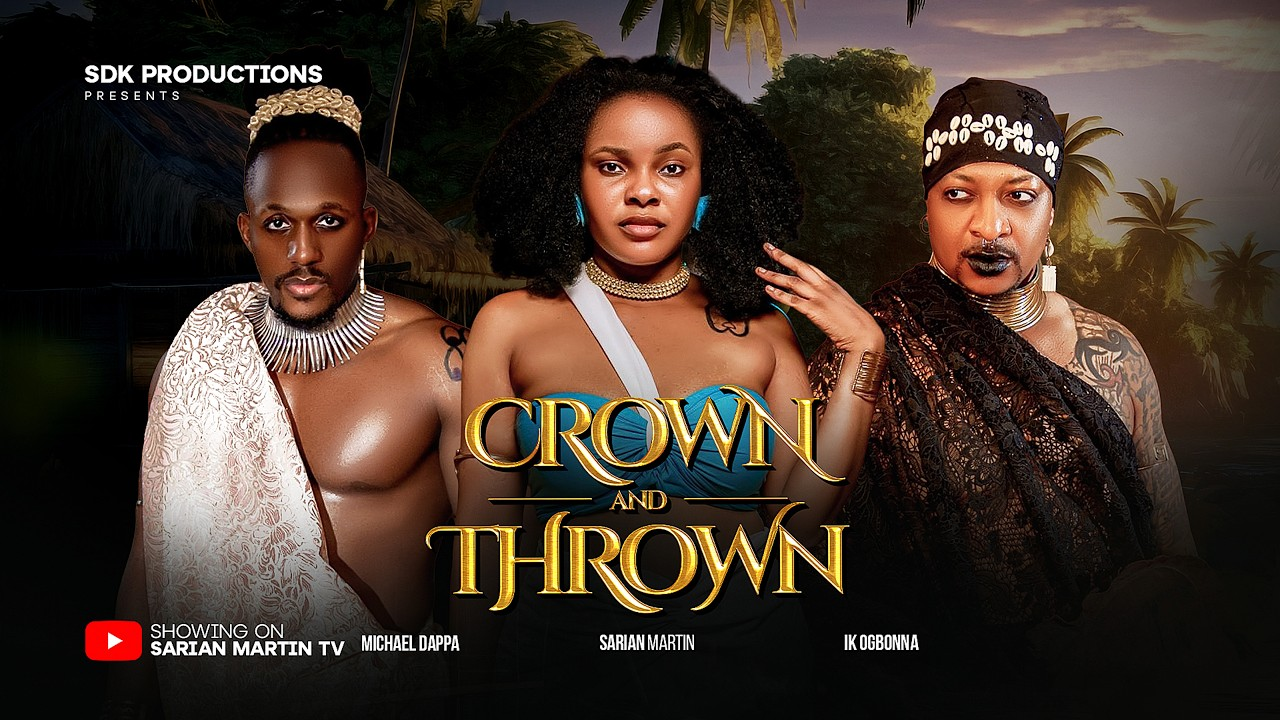
The year 2026 has already delivered some cinematic heavyweights, but few carry the atmospheric gravity of Sarian Martin’s latest magnum opus, Crown and Throne. Starring the powerhouse trio of Sarian Martin, Michael Dappa, and Ik Ogbonna, this isn’t just another “royalty and maid” trope. It is a searing, 111-minute interrogation of power, the “Pure vs. Impure” caste systems, and the heavy price of social evolution.
If you’ve been tracking the evolution of the Nigerian film industry, Crown and Throne represents the pinnacle of “New Nollywood” meeting “Traditional Epic.” It’s a film that demands you look past the beads and the palaces to see the bleeding heart of a nation in transition.
The Prophetic Stranger: Sarian Martin as the Defiant Zora
At the center of this storm is Zora, played with a haunting, steel-eyed resolve by Sarian Martin. From her first appearance, Zora is established not as a victim of her circumstances, but as a philosophical antagonist to the status quo.
In a standout sequence early in the film [00:29:39], Zora delivers what is arguably the most viral-ready monologue of the year. When challenged on her defiance, she retorts:
“Leadership is about taking strokes for your people… it is about giving your last food to someone hungrier than you.”
Martin avoids the “damsel in distress” trap. Even when caught between two warring monarchs, her character remains the ideological engine of the film. She isn’t a prize to be won; she is a mirror reflecting the moral decay of the kingdoms of Bakya and Kiza.
A Tale of Two Kings: Michael Dappa vs. Ik Ogbonna
The film brilliantly contrasts two styles of African monarchy through King Kiza (Michael Dappa) and King Bakya (Ik Ogbonna).
The Burden of Kiza (Michael Dappa)
Dappa portrays Kiza as a man haunted by both dreams and a dying land. His kingdom is suffering from a three-year drought, a physical manifestation of a spiritual blockage. Dappa plays Kiza with a quiet, simmering vulnerability. His chemistry with Martin is grounded in intellectual curiosity rather than raw lust, which makes their partnership feel earned.
The Charisma of Bakya (Ik Ogbonna)
On the other side of the river, Ik Ogbonna’s King Bakya represents the “Old Guard”—protective, impulsive, and deeply traditional. Ogbonna brings a commanding physicality to the role. When he invades Kiza’s palace demanding Zora’s return [01:35:25], the tension is palpable. The “Peace Treaty” between the two kingdoms is stretched to its breaking point, providing the film’s most high-stakes political drama.
The “Pure vs. Impure” Conflict: Tackling the Osu Taboo
The emotional core of Crown and Throne lies in its brave handling of the abolition of slavery. The film dives deep into the “Pure vs. Impure” narrative—a thinly veiled reference to historical caste systems like the Osu in Igboland or similar hierarchical structures across West Africa.
The scenes involving the Council of Chiefs are particularly chilling. Their argument—that slavery is an “ancestral tradition” necessary to keep the bloodlines pure—is met with Zora’s unwavering logic. The film asks a difficult question: Can a culture survive if it cuts out its own rot? When the rain finally falls, it isn’t just a weather event; it’s a narrative baptism, signaling that the heavens favor progress over stagnant tradition.
Visual Splendor: Production and Cinematography
Visually, the film is a masterclass in differentiation.
• The Kingdom of Kiza is bathed in earthy tones, dust, and golden light, emphasizing the drought and the longing for renewal.
• The Kingdom of Bakya utilizes lush greens and deep blues, representing a more established, albeit rigid, power structure.
The costume design deserves a special mention. The intricate beadwork on the Queen Mother (Majestra) contrasts sharply with the raw, textured fabrics worn by the slaves, visually reinforcing the divide that Zora eventually seeks to bridge.
The Twist Ending: Freedom Over the Crown
Without giving away too many spoilers, the resolution of Crown and Throne subverts every romantic expectation. In a traditional epic, Zora would marry a King and become the “Slave Queen.”
Instead, the film chooses a path of Total Autonomy. Zora’s decision to head toward England to find her roots [01:48:13] is a powerful statement on the African diaspora and the search for identity beyond the titles given to us by others. She chooses the “Throne of her Ancestors” over the “Crown of a King.”
The Verdict: A 2026 Masterpiece
| Category | Score |
| Acting | 9.5/10 |
| Story & Script | 9.0/10 |
| Production Design | 8.5/10 |
| Cultural Impact | 10/10 |
| Overall Rating | 9.3/10 |
My Thoughts: Why You Must Watch This
Crown and Throne is more than a movie; it’s a conversation starter. It challenges us to look at the “chains” we still carry in the form of prejudice and outdated traditions. Sarian Martin has solidified her place as a content expert and a storytelling titan with this project.
Call to Action: Do not miss the cinematic event of the year. Grab your popcorn, gather your family, and witness the fall of the old world and the rise of the new.
What did you think of Zora’s decision at the end? Was she right to leave the Kings behind? Let us know in the comments below!
#NollywoodTimes
#CrownAndThrone
#SarianMartin
#Nollywood2026










Leave a Reply