
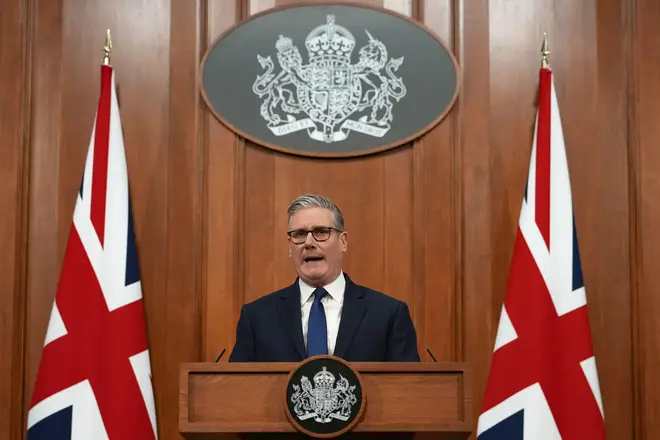
UK’s Prime Minister Keir Starmer has warned that how Britain responds to the Iran crisis “will define us for a generation,” as he outlined the government’s approach to the conflict and its economic impact.
Speaking at a Downing Street press conference, Starmer stressed that the UK would not be drawn into the war, stating: “This is not our war, we will not be drawn into the conflict. That is not in our national interest.”
However, he said Britain would take a leading diplomatic role, particularly in efforts to reopen the Strait of Hormuz, which has been disrupted by the conflict. He described reopening the vital shipping route as “the most effective way we can support the cost of living in Britain.”
The Prime Minister added that Foreign Secretary Yvette Cooper would host talks involving 35 countries later this week to “assess all viable diplomatic and political measures we can take to restore freedom of navigation.”
Starmer also pointed to a recent reduction in household energy costs, noting that the Ofgem price cap has fallen to £1,641 for an average dual-fuel household until June 30, a 6.6% decrease from the previous quarter. The briefing marked his third public update on the crisis, which has driven up global oil and gas prices and raised concerns about economic stability.
Meanwhile, US President Donald Trump criticised the UK for not joining military strikes in the Middle East, suggesting countries affected by supply disruptions should “build up some delayed courage, go to the Strait, and just TAKE IT.”
Responding, Starmer reaffirmed Britain’s commitment to NATO, saying: “NATO is the single most effective military alliance the world has ever seen, and it has kept us safe for many decades, and we are fully committed to NATO. And secondly, whatever the pressure on me and others, whatever the noise, I’m going to act in the British national interest in all the decisions I make.”
The conflict has already begun to impact UK consumers, with fuel prices rising sharply. According to the RAC, diesel prices have increased by 40p to 182.8p per litre, while petrol has risen by 20p to 152p per litre.
Chancellor Rachel Reeves warned that cutting fuel duty or VAT could risk fuelling inflation, adding that any future support for households would need to be targeted. “I want to learn the lessons of the past because when Russia invaded Ukraine, the richest, the best-off third of households got more than a third of the support. That makes no sense at all,” she said.
#Iran #war #affect #future #country








Leave a Reply