
Introduction: The Perpetual Battle for the Soul
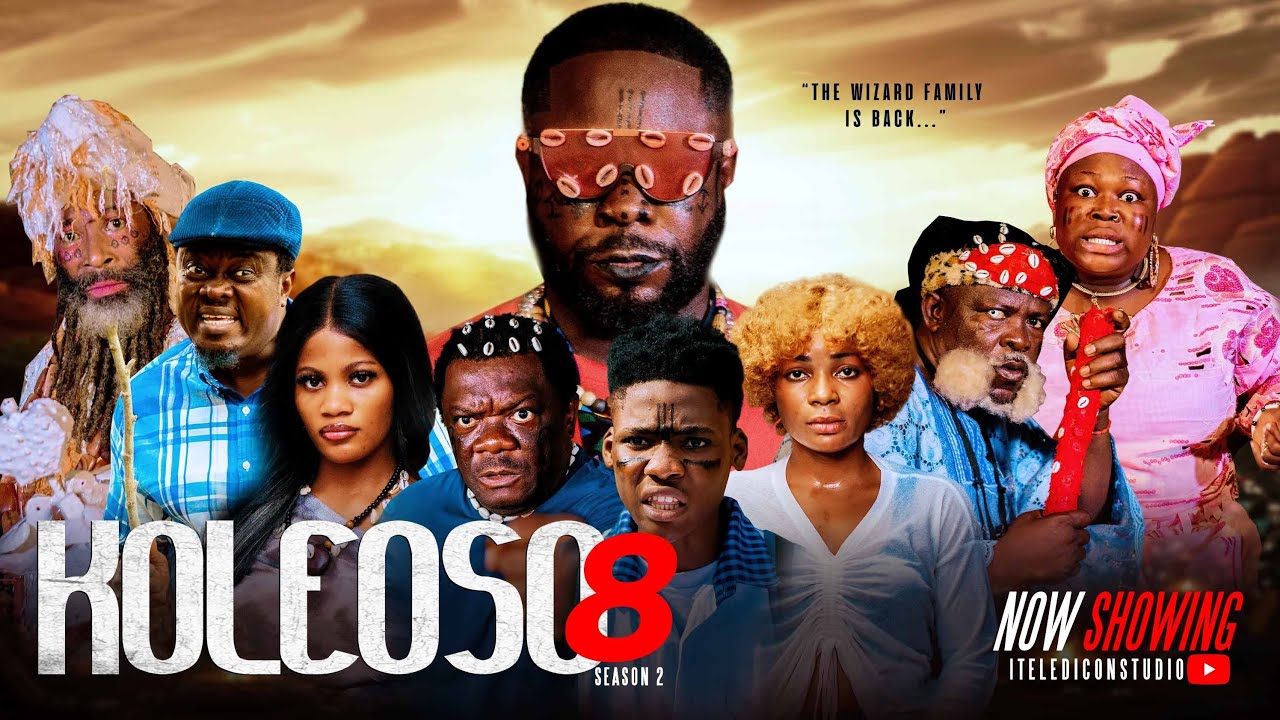
When destiny awakens, silence breaks. In Koleoso Part 8, unseen forces stir, ancient secrets refuse to stay buried, and a storm brews in the spiritual realm. Released December 12, 2025, by Iteledicon Studio on YouTube, this episode stars Muyiwa Ademola, Iteledicon, Kemity, and Ogboluke in a pulse-pounding clash of loyalty, power, and supernatural wahala. Will light triumph over darkness? Drop your prediction in the comments!
“Koleoso,” a saga long captivating the Yoruba Nollywood audience, returns with Part 8 of Season 2 and it does not offer a moment of rest. Clocking in at over 75 minutes, this installment from Iteledicon Studio and directed by Ibrahim Yekini, is less a single chapter and more a relentless, middle-of-the-story escalation of the conflict that has defined the series. If you’re a newcomer, prepare for an immediate, deep dive into a world ruled by family betrayal, spiritual warfare, and the heavy price of ambition. For loyal fans, this part delivers on its promise, shedding all pretense of peace and declaring, as one character notes, that “this war is just getting started.”
This review, broken down using the comprehensive analysis framework, will dissect the narrative coherence, the power-packed performances by legends like Muyiwa Ademola and the ever-versatile Kemity, and the technical execution that brings this high-stakes family drama to life.
Narrative and Plot Analysis: A Web of Unresolved Conflict
The Burden of Part 8: Standing Alone vs. The Continuum
A critical challenge for any mid-series installment is its ability to engage both long-time viewers and accidental newcomers. Koleoso pt 8 largely succeeds by centering its conflict on universally understood themes: generational rivalry and the fight for legacy. While the underlying mythology and history of the family are complex, the present-day stakes—a fight for wealth, freedom, and the future of the younger generation—are immediately apparent.
The plot expertly juggles three primary threads, a common complexity in modern Nollywood storytelling:
The Core Revenge Plot: The main, shadowy war being waged between the central family unit and a set of relentless antagonists (a character calls it an “elephant” movement that needs a leader to be defeated). This plot is driven by mystic elements and high-stakes maneuvering.
The Domestic/Financial Struggle: The very human element of the battle, manifesting in financial struggles, legal/school admissions drama, and tense spousal interactions.
The Younger Generation’s Crisis: The subplot involving the sister fighting for her brother’s school admission and the subsequent confrontation with a bully, which introduces the key new character, Shola.
Pacing and Climax: Building the Pressure Cooker
The film’s pacing is strategically tight. It avoids the long, expository flashbacks that often plague series sequels, instead opting for forward momentum. The first half is dedicated to raising the tension: the school admission scene, the domestic arguments fueled by financial pressure, and the protagonist’s realization that their enemy is too numerous and powerful.
The climax of the film is less a singular, explosive event and more a series of dramatic confrontations:
The School Office Showdown (Tension Riser): The sister’s desperate attempt to get her brother admitted turns into a powerful, painful scene as the principal asks invasive questions about the boy’s “biological father,” hitting on a very personal wound.
The War Council (Strategy Scene): The gathering of the protagonists to discuss the next move is where the thematic heart lies. The line, “the enemy of my enemy is my friend,” sets up the dramatic alliance with unexpected allies, promising explosive developments in Part 9.
The Street Confrontation (Action Climax): The young woman, harassed by a local boy (a bully), is dramatically saved by the newcomer, Shola. This scene is vital, as it introduces a character with immediate protective instincts, perhaps destined to be a hero in the war to come.
Dialogue and Thematic Depth
The film’s use of language is quintessentially modern Nollywood: a seamless blend of formal Yoruba, Pidgin English, and a smattering of formal English. This mix enhances the authenticity of the characters.
The overriding theme is Legacy versus Survival. The line, “because education is the best legacy,” is a powerful moment, but it’s immediately undercut by the reality that surviving the ongoing “war” is the only thing that guarantees any legacy. This juxtaposition between the mundane, yet essential, drama of a school admission and the deadly, spiritual conflict elevates the film beyond typical melodrama.
Character and Performance Review: Giants and Newcomers
The performances in Koleoso pt 8 are the bedrock that supports the sprawling narrative. The cast, featuring veterans and talented newcomers, ensures the emotional stakes feel earned.
Muyiwa Ademola: The Embattled Patriarch
Muyiwa Ademola, as the patriarch, is the central pillar of the performance. His portrayal is one of mounting, barely contained frustration. He carries the weight of the family’s war on his shoulders. He is not just fighting the external enemy; he is fighting the internal one—the constant fear, the financial strain, and the sense of failure as a provider. His outburst demanding his wife “mention something tangible that you’ve ever done for this family” is a raw, devastating look at the breakdown of a partnership under extreme pressure. He masterfully conveys the exhaustion of a man who knows he is a “chameleon that can take different shape” but is losing the will to keep shifting.
Kemity: The Resilient Fighter
Kemity provides a powerful counterpoint. Her character’s arc in this installment focuses on fierce protectiveness. Her advocacy for her younger brother in the face of the principal’s probing questions is delivered with a subtle mix of deference and steeliness. She is the practical fighter, dealing with the realities of life (school, bullies) while her elders manage the spiritual plane. Her interaction with the new character, Shola, is a beautifully played scene, hinting at a potential alliance built on immediate trust and shared vulnerability.
The New Face: Shola
The introduction of Shola and his father is critical. Shola is presented as an unassuming protector, his intervention in the bullying incident a clear signal of his role. This character introduction is highly effective—it’s not mere filler, but a direct response to the family’s greatest need: reliable, external allies. The final scene, where the alliance is formed under the principle, “the enemy of my enemy is my friend,” is electric because the actors sell the desperate, uneasy nature of this new pact.
Technical and Production Quality: Nollywood on a Rise
The production quality of Koleoso pt 8 is commendable and reflects the rising standards of Yoruba filmmaking.
Cinematography and Editing
The camera work is generally stable and professional, focusing on close-ups during moments of high drama to capture the emotional intensity (e.g., the wife’s reaction to the husband’s accusation). The editing is brisk, especially during the strategy sessions, preventing the dialogue-heavy scenes from becoming static.
A slight drawback, however, is the uneven transition between the spiritual/mystical scenes and the domestic drama. The visual language for the “war” elements is sometimes less impactful than the raw realism of the scenes set in the school or home.
Sound and Music
The sound design is where the film sometimes falters. While the dramatic score effectively underscores key moments, there is a tendency to rely on overly dramatic, almost cartoonish sound effects during moments of confrontation or surprise. This is a common Nollywood trope, but it occasionally breaks the sense of realism built by the strong performances. The authentic street sounds and background noise in the Pidgin-heavy conversations, however, greatly enhance the realism of those settings.
5. Overall Critique & Recommendation
Koleoso pt 8 (season 2) is not a complete meal; it is a vital, high-octane part of a grand feast. It is a film that functions by elevating stakes and setting up dramatic payoffs for the next installment. The sheer energy and commitment from the lead actors, particularly Muyiwa Ademola and Kemity, provide a masterclass in conveying stress, weariness, and survival instinct.
The film’s greatest strength is its ability to ground the ethereal, spiritual warfare in the agonizing reality of everyday life: a school admission, a marital quarrel, a financial crisis. It reminds the audience that the greatest battles are often fought in both the boardroom and the bedroom. Its weakness lies primarily in its inability to offer a clean resolution, but that is the nature of a successful series—it leaves you hungry for more.
My Verdict: 4/5 Stars (A Highly Effective Mid-Series Escalation)
Call-to-Watch: Do Not Retreat!
If you have been following the Koleoso series, Part 8 is non-negotiable viewing. It is the tactical movement before the final, rumored confrontation. If you are looking for an introduction to high-stakes, well-acted Yoruba drama that expertly mixes family rivalry, corporate maneuvering, and traditional mysticism, start with Season 1, but prepare for the intensity that awaits you here.
Click the link and witness the latest maneuver in the war that has gripped Nollywood. The time for surrender is over; “no retreat, no surrender.”
#NollywoodTimes
#LatestYorubaMovie2025
#ItelediconStudio
#MuyiwaAdemola
#NollywoodMovies
#TrendingYorubaMovie
#AfroMagic
#NaijaVibes
#SpiritualThriller










Leave a Reply