
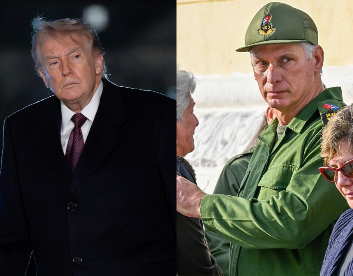
Russia has reacted to remarks by U.S. President Donald Trump suggesting he could “take” the island nation of Cuba.
The Cuban Ministry of Energy and Mines posted on social media on March 16 that its National Electric System (SEN) suffered a “total disconnection,” without providing details as to the cause of the electrical grid collapse or how long until all of the country’s 10 million inhabitants are expected to have power again.
The blackout became the third major one in the country over the past four months.
Trump, whose Administration has reportedly been working to remove Cuba’s current leader, President Miguel Díaz-Canel (pictures top right), has suggested that he will turn his attention to Cuba next once the conflict with Iran is resolved.
Trump has already forced at least two major regime changes this year: killing Iran’s Supreme Leader Ayatollah Ali Khamenei late last month amid U.S.-Israeli joint military operations, after capturing Venezuela’s President Nicolás Maduro in a daring military operation in early January, the latter of which exacerbated Havana’s current crisis.
“I think Cuba is seeing the end,” Trump told reporters in the Oval Office on March 16, adding that he believes he’ll have the “honor” of “taking” the country. “They’re a very weakened nation right now.”
Efforts are underway to restore power, but such electrical grid collapses have become more common in Cuba, which has been, for decades, ravaged by an economic crisis that has seen acute shortages of food, fuel, and electricity. The situation has been aggravated by longstanding sanctions from the U.S., in a bid to topple Cuba’s communist regime.
In a statement on Tuesday, March 17, Russia said it stands in “unwavering solidarity” with the Cuban government and its people, while condemning what it described as interference in the affairs of a sovereign state.
Without mentioning Trump directly, Russia’s foreign ministry warned against intimidation and unilateral sanctions.
The reaction came after Trump said he expected to have the “honour of taking Cuba” and claimed he could “do anything” he wanted with the communist-run country.
Moscow said it remains in contact with Cuban leadership and is ready to provide support, including financial assistance, as the island faces mounting economic and energy challenges.
According to Russian officials, Cuba is dealing with “unprecedented” difficulties caused by long-standing U.S. sanctions and a recent energy embargo, which has worsened the country’s already fragile power system.
Reports also suggest that Washington is pushing for political changes in Havana, including the possible removal of Cuban President Miguel Díaz-Canel, although no official confirmation has been made.
For decades, Cuba has been run by the Castros, first led by the infamous revolutionary Fidel Castro, who ousted a U.S.-backed regime in Havana in 1959 and allied with the then-Soviet Union to establish Cuba as a socialist state.
Before Fidel Castro died in 2016, he handed the presidency over to his brother Raúl, who led the country as the Communist Party’s First Secretary until 2021.
Even as Raúl Castro stepped down in 2018 to make way for incumbent President Díaz-Canel, he and other Castro family members remain key figures in Cuban politics.
Cuba and Russia have maintained close ties since the 1959 revolution that brought Fidel Castro to power, and Moscow has continued to support the island in recent years through financing and material aid.
The latest developments signal rising tensions between global powers, with Russia backing Cuba while the United States increases pressure on the Caribbean nation.
#Russia #reacts #Trump #Cuba #communistrun #country #weak





Leave a Reply