
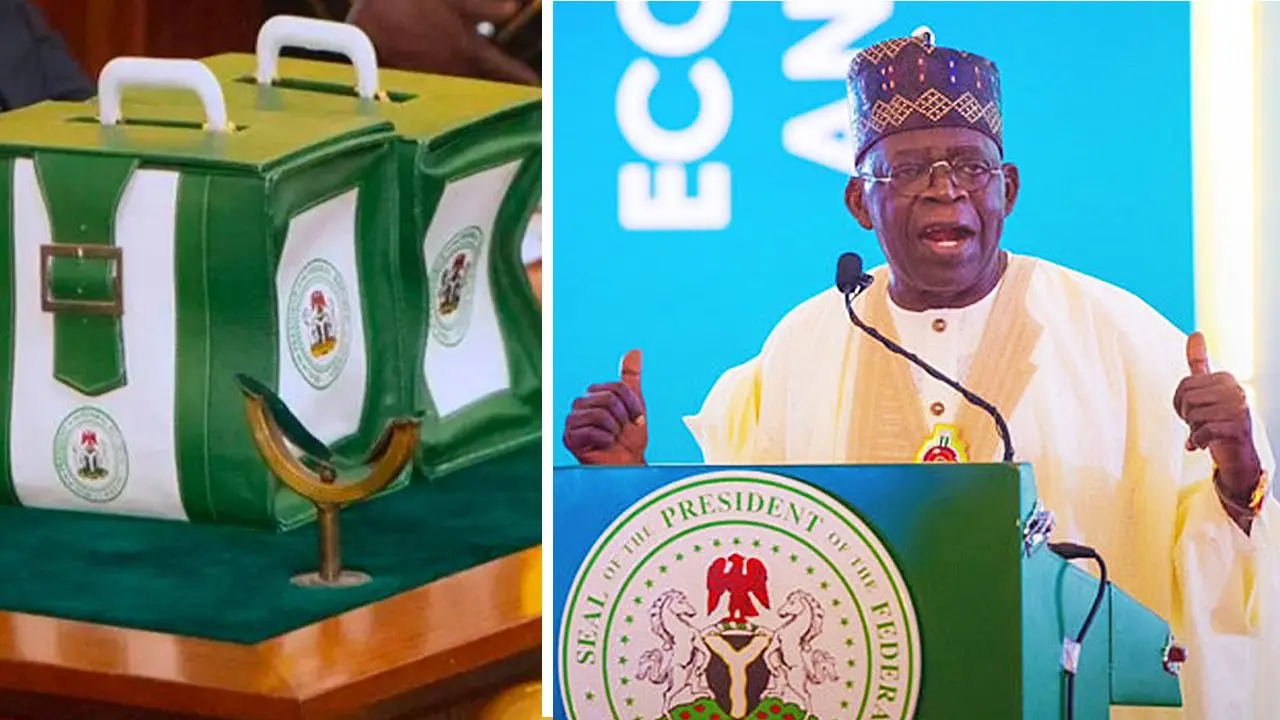
The Senate today March 31, passed the 2026 Appropriation Bill of N68.32 trillion, a significant increase from the N58.47 trillion initially presented by President Tinubu in December 2025.
The upper chamber approved the revised figure following a formal request by President Tinubu, who had earlier written to the Senate to notify it of an upward review of the 2026 budget to accommodate additional fiscal realities and national priorities.
The President themed the budget as the “Budget of Consolidation, Renewed Resilience and Shared Prosperity” and said it is designed to consolidate macroeconomic stability, improve the business environment, promote job creation, and reduce poverty while strengthening human capital and protecting vulnerable Nigerians.
The approved sum of N68,323,309,818,667 comprises N4.8 trillion for statutory transfers, N15.81 trillion for debt servicing, N15.43 trillion for recurrent expenditure, and N32.29 trillion for capital expenditure, with the capital component taking the largest share in line with the government’s infrastructure and development agenda.
The increase in the budget size followed the inclusion of N7.71 trillion to cover outstanding capital obligations carried over from the 2025 fiscal year, as well as an additional N2 trillion for priority projects across multiple sectors that were not captured in the original proposal.
Lawmakers noted that many of the 2025 capital projects were unlikely to be completed before the budget expired, necessitating their rollover into the 2026 fiscal framework.
The Senate also approved several strategic interventions contained in the President’s request, including N478.6 billion as equity contribution for presidential legacy light rail projects in Lagos, Kano, Kaduna, and Ogun states, as well as feasibility studies for Enugu and Maiduguri urban rail systems. It further approved N8.96 billion for feasibility studies for the Calabar–Maiduguri corridor and the Maiduguri–Sokoto superhighway.
In the health sector, N482.76 billion was provided for priority interventions tied to existing bilateral commitments. At the same time, the judiciary received significant allocations, including N98.5 billion for the Court of Appeal, N36.7 billion for the Supreme Court, and N268.54 billion to strengthen judicial capacity and support the anticipated increase in the number of judges ahead of the 2027 general elections.
#Senate #passes #N68.3trn #budget














Leave a Reply