
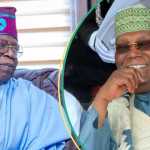
As the countdown to the 2027 presidential election begins, Nigeria’s political landscape is once again brimming with tension, strategy, and shifting alliances. According to NewsVista reporter, some notable figures in the National Opposition Coalition—led by former Vice President Atiku Abubakar and ex-Kaduna State Governor Nasir El-Rufai—are deep in consultation over their next move.
Atiku, who has long stood at the forefront of opposition politics, recently declared that unseating President Bola Ahmed Tinubu in 2027 is only possible through a formidable coalition. His calls for unity have sparked intense conversations among political elites, including former Labour Party candidate Peter Obi, ex-Secretary to the Government of the Federation Babachir Lawal, and former NPA board chairman Akin Ricketts.
Atiku’s reemergence as a central figure has reignited debates across the country: can he finally clinch victory if he secures the coalition’s ticket?
Here are three reasons why Atiku might stand a real chance this time around:
Widespread Political Reach
Atiku, hailing from Adamawa State, has spent decades cultivating relationships across Nigeria’s geopolitical zones. His deep-rooted network and nationwide appeal could be a game-changer, especially if the coalition manages to stay united. Many political actors still view him as someone who prioritizes national unity and stability—qualities that resonate strongly in a country grappling with division and unrest.
The “Unifier” Narrative Still Holds Power
Among his supporters, Atiku is affectionately dubbed “The Unifier”—a title that speaks to his long-standing message of healing regional and religious divisions. He has consistently voiced support for marginalized groups and pledged to restore cohesion in the country if elected. For voters yearning for a president who speaks of national inclusion, this identity could carry significant weight.
Frustration With the Status Quo
The economic strain since President Tinubu took office has not gone unnoticed. Inflation has soared, food prices have skyrocketed, and many households are struggling to meet basic needs. According to NewsVista findings, public discontent is growing louder, especially in areas plagued by insecurity and dwindling agricultural output. With farmers in northern regions under constant threat from insurgents, food scarcity continues to worsen. For many Nigerians, change is not just desired—it’s demanded.
Will the Veteran Run Again?
At 78, Atiku remains one of Nigeria’s most persistent presidential contenders. He has thrown his hat into the ring six times—in 1993, 2007, 2011, 2015, 2019, and 2023. His most promising chances were in 2019 and 2023, when he came second to President Tinubu with nearly 7 million votes—just under 2 million short of the winning mark.
Despite his resilience, Atiku’s ambitions are not without controversy. Some voices within the coalition argue that the time has come for new leadership. They point to internal rifts within the PDP, allegedly caused by Atiku’s repeated bids for the presidency. There’s also growing resistance from leaders who insist on respecting the zoning principle, which calls for power to rotate to the south—an idea that directly clashes with Atiku’s intentions.
Coalition Platform Still in Progress
Earlier speculation suggested Atiku’s camp had settled on the All Democratic Alliance (ADA) as the official coalition vehicle. However, AbdulRasheed Shehu, his special assistant on media, clarified that no final decision has been made. According to NewsVista reporter, several internal matters are still being ironed out before any coalition structure is formally announced.
Whether or not Atiku will lead the charge in 2027 remains uncertain. But one thing is clear: the road to the presidency will be shaped by unity, strategy, and the ability to channel public discontent into political momentum.








Leave a Reply