
The Ghana Tertiary Education Commission (GTEC) has issued a clarification to address growing public misunderstanding about the regulation and approval of distance learning centres run by public universities.
This follows recent debate sparked by an earlier communication from the Commission on the operation of such centres nationwide.
GTEC emphasised that it has not declared distance learning programmes offered by public universities as unapproved or invalid.
It also firmly rejected claims that institutions such as the University of Education, Winneba (UEW), University of Cape Coast (UCC), University for Development Studies (UDS), and the University of Ghana (UG) have been blacklisted or barred from running distance education programmes.
The Commission explained that its earlier directive was intended to ensure proper oversight and compliance, not to discredit accredited programmes or institutions.
“Contrary to misinformation being shared, GTEC has not declared the distance learning programmes of UEW, UCC, UDS, or UG as ‘unapproved places to pursue tertiary education’,” the statement clarified.
It stressed that these institutions remain fully accredited and recognised, adding that their distance-learning programmes are acceptable when properly structured, resourced, and approved.
A key emphasis of the Commission’s clarification is that accreditation in higher education is not automatically extended to all satellite or study centres affiliated with a university.
GTEC explained that accreditation is “campus-specific and location-dependent”, meaning that each study centre must undergo separate assessment and approval.
Approval is therefore not blanket or transferable across all locations linked to a university.
According to the Commission, each centre must meet strict minimum requirements, including adequate infrastructure, qualified teaching staff, library and ICT facilities, and effective learner support systems.
It warned that any centre operating without explicit approval, even if linked to a recognised public university, is not officially authorised to deliver tertiary academic programmes.
GTEC also raised concerns about the increasing use of non-traditional and informal spaces for distance learning activities without regulatory approval.
These include secondary schools, corporate training centres, churches, and other makeshift venues being used to host tertiary-level academic programmes.
The Commission said such facilities often fall short of required standards for higher education delivery.
It stated clearly that these venues are not permitted to operate as distance learning centres unless they have undergone formal evaluation and received approval from GTEC.
Despite the concerns raised, GTEC reaffirmed its support for distance learning as a legitimate and strategic method of expanding access to tertiary education in Ghana.
However, it stressed that such programmes must meet strict quality assurance requirements.
These include the provision of suitable physical and digital infrastructure, qualified academic personnel, robust student support systems, and formal approval of each study centre by the regulator.
Institutions have been urged to take steps to regularise all distance learning operations by submitting their centres for inspection and accreditation.
GTEC further advised prospective students and the general public to exercise caution when selecting distance learning centres.
It encouraged individuals to verify the accreditation status of any facility directly through the Commission or the relevant university’s distance education directorate before enrolling.
The Commission also cautioned against reliance on social media reports and unverified claims, warning that misinformation could lead students to enrol in unapproved or substandard institutions.
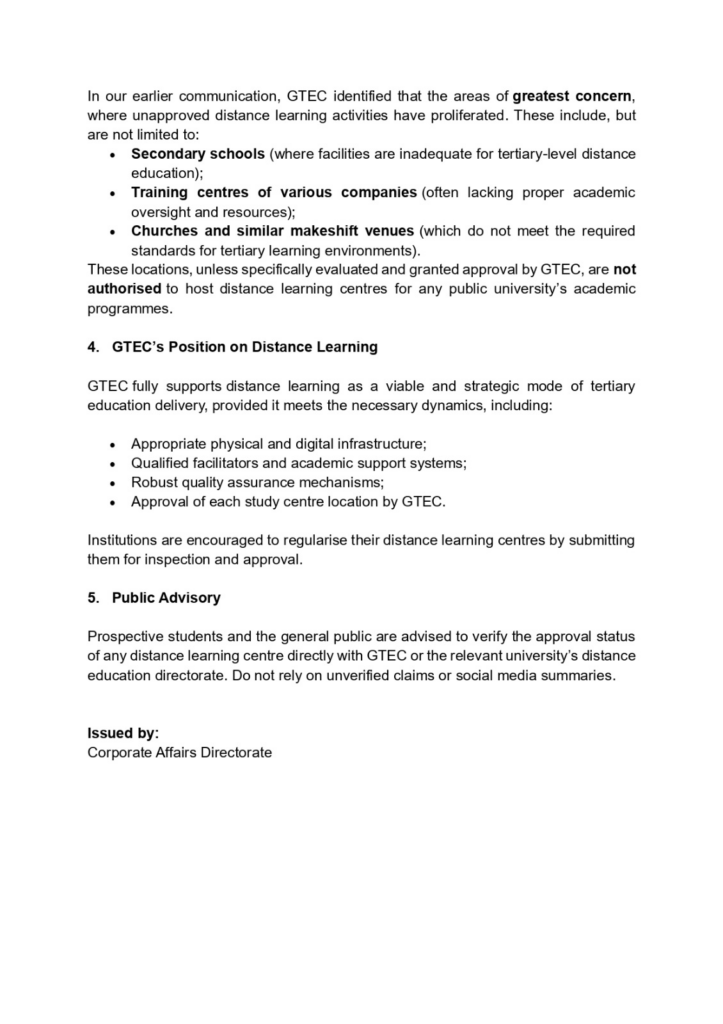
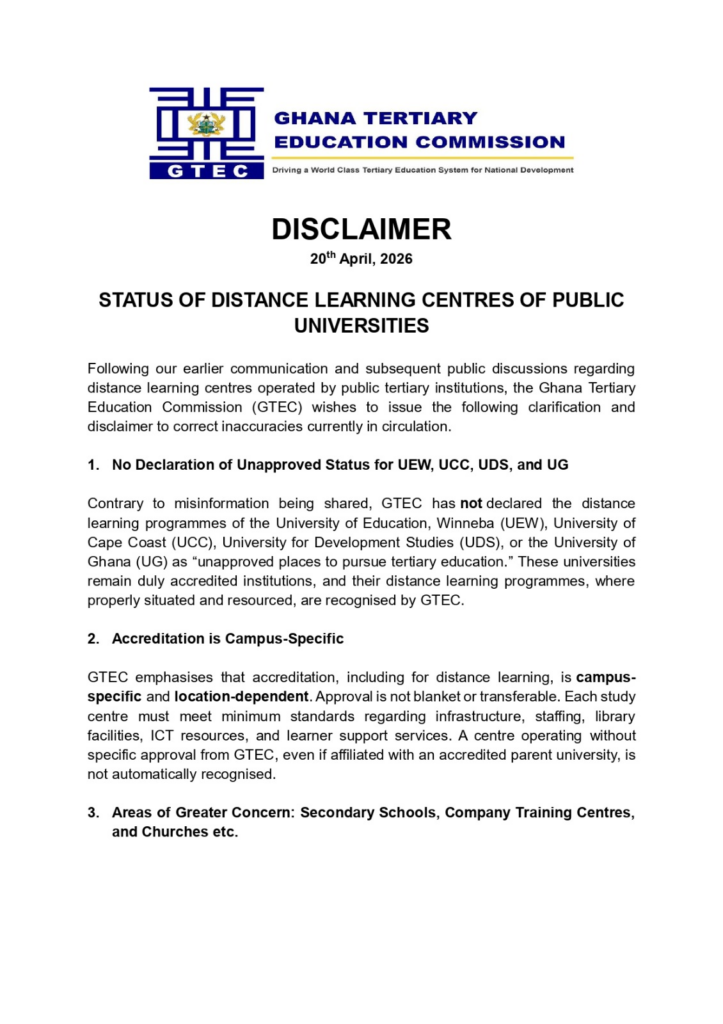
Below is the full statement
Read Original#ban #public #universities #distance #learning #programs …WATCH THE VIDEO HERE














Leave a Reply