
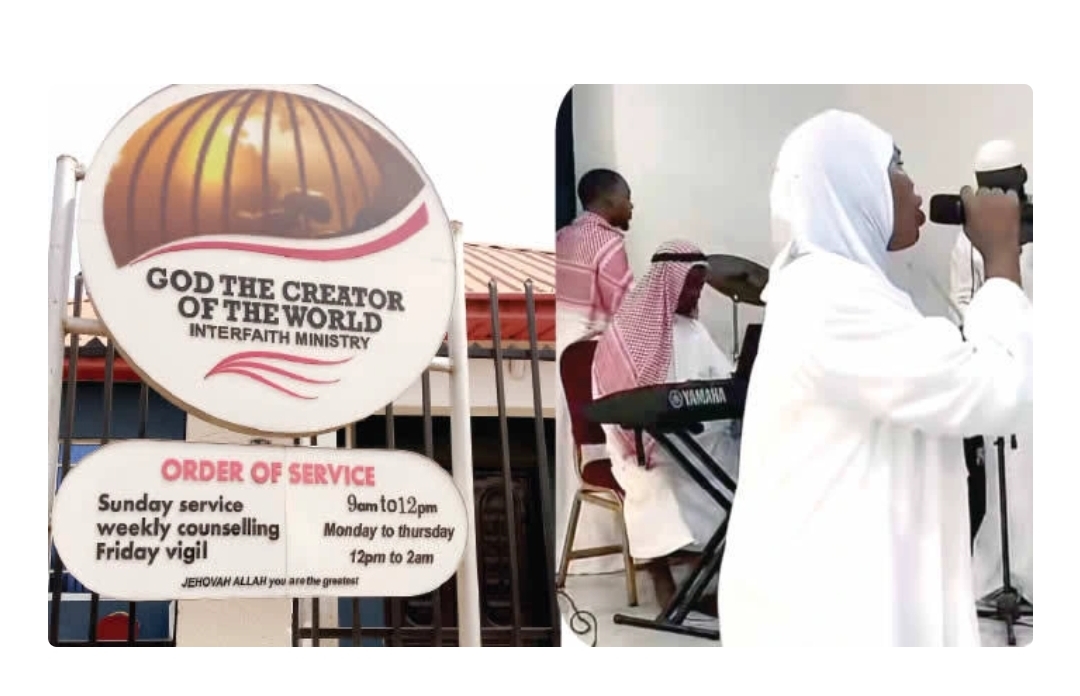
According to Punch, a bustling Lagos suburb is home to a unique temple with an extraordinary mission: to bridge the gap between Christianity and Islam, two of the world’s largest religions. In this sacred space, worshippers sing hymns and recite Quranic verses side by side, embodying a rare harmony in a world often marred by religious division. Aptly named the God the Creator of the World Interfaith Ministry, the temple stands as a testament to unity.
Located on Lasisi Osaju Street, Ikotun, Lagos State, the temple greets visitors with a modest signpost that reads, “Jehovah Allah, you are the greatest.” This declaration captures the temple’s essence: a commitment to fostering interfaith dialogue and dismantling barriers that divide religious communities.
Inside, the temple radiates an aura of tranquility. Sunlight streams through the windows, illuminating its clean-tiled floors. Worshippers, dressed in a blend of Christian and Islamic attire, gather with a shared purpose. Women in flowing abayas sit beside others in vibrant church dresses, presenting a visual tapestry of unity and culture.
The service begins with a charismatic leader who blends traditional Muslim and Christian attire. His sermon weaves references from the Bible and Quran, focusing on universal values such as love, charity, and peace. The congregation listens attentively, their shared devotion bridging centuries-old divides.
The temple’s choir embodies its mission perfectly. Clad in a mix of choir robes and traditional tunics, they lead worshippers in songs that merge Christian hymns with Islamic melodies. The music rises as a powerful chorus, transcending language and belief. Children play together in the aisles, blissfully unaware of the religious labels that often divide adults.
For many, this temple is more than just a place of worship—it is a community where love and understanding thrive. “We help each other grow and support one another, whether you want to go to Jerusalem or Mecca. As long as you’re serving God, there’s support here,” says Alhaji Morzuq Ibrahim, a devoted member of over a decade.
The temple’s founder, Prophet Mobolaji Ganiyu Elijah Oshoba, was deeply influenced by his upbringing in a mixed-religion family. Born in Lagos, he was exposed to both Christianity and Islam, experiences that inspired his interfaith vision. In 2009, he claimed to have received a divine revelation urging him to create a space where all could worship God without division.
“God does not have a religion,” Oshoba asserts. “There is no portion in the Quran or Bible where God said someone would be called a Muslim and another a Christian. Jesus was not a Christian when he was alive.”
Oshoba explains that the temple’s mission is grounded in a deeper understanding of faith. “Jesus is our Rabbi, which means teacher. He is the Lord, too, in the sense of being a guide. Mohammed is the Lord of Islam because he was and still is the person that God uses.”
For members like Mary Kemi, the temple’s interfaith approach feels natural. Raised by a Muslim mother and a Christian father, she grew up embracing both faiths. “When people ask, I tell them I go to a place where Christians and Muslims worship. We sing both Christian and Muslim songs,” she says.
Another member, Ajibola Oshoba, initially struggled with the temple’s teachings but eventually embraced its message of unity. “Religious discrimination should be abolished. It only stunts growth,” he says. His journey to understanding Jesus as a teacher, rather than God, reflects the temple’s emphasis on personal and inclusive faith.
The temple incorporates elements of both Christian and Islamic traditions. Daily Muslim prayers are held alongside Christian-style sermons. While the temple does not celebrate Christmas, it observes fasting periods like Ramadan and Lent, reflecting its inclusive ethos. Its architecture, a blend of church and mosque designs, further symbolizes this union.
Prophet Oshoba believes that many religious divisions stem from language barriers and manipulation. “Allah is simply the Arabic word for God, just as Yoruba people say Eledumare and Igbo people say Chineke,” he explains. Misinterpretations of sacred texts, he argues, have led to unnecessary strife. He encourages believers to read the Quran and Bible with hearts open to peace and understanding.
In this temple, rituals and sacrifices are absent. Worship focuses solely on connecting with God. Oshoba challenges conventional teachings, asserting that the true essence of Jesus and Mohammed lies in their roles as guides to humanity.
The temple’s impact extends far beyond its walls. It has become a beacon of hope for those seeking a faith that unites rather than divides. Through its unique practices, it challenges long-held religious notions and invites believers to see the shared humanity in all.
“Our goal is to serve God, not a religion,” Oshoba declares. “Whether you call Him Jehovah or Allah, the essence is the same. It’s time we rise above labels and truly embrace one another as children of the same Creator.”



Leave a Reply