
Abstract
The December 2025 U.S. airstrikes in Sokoto, Nigeria, mark a critical inflexion point in West African security architecture. Following its expulsion from Niger, Washington has deployed a distributed “light footprint” across Ghana, Benin, Côte d’Ivoire, and Chad—a novel operational model that reduces coup vulnerability while increasing regional dependency.
This paper documents three converging dynamics: 1) the shift from advisory support to direct kinetic intervention, justified through instrumentalized religious persecution narratives that obscure multifaceted governance failures; 2) Nigeria’s acceptance of foreign strikes despite sovereignty costs, reflecting capability gaps in precision airpower; and 3) the emergence of asymmetric security dependencies that risk entrenching external military presence under a humanitarian guise. Drawing on operational analysis and threat assessment, the paper proposes five African Union institutional mechanisms—from post-strike accountability protocols to continental drone policies—designed to reassert African agency before externalised counterterrorism becomes the irreversible norm.
Keywords: sovereignty, counterterrorism, West Africa, miltary footprint, African Union, Nigeria, security dependency
I. Introduction
On Christmas Day 2025, the United States (U.S.) conducted a series of significant airstrikes against Islamic State targets in Sokoto State, northwestern Nigeria, representing a marked escalation in U.S. military involvement in West Africa.
This paper aims to sound an early strategic warning by critically analysing the shift toward foreign kinetic intervention in West Africa, the instrumentalisation of religious narratives in counterterrorism, and the emergence of a distributed external military footprint, and assessing how these dynamics risk undermining sovereignty, inflaming sectarian tensions, and
entrenching neocolonial security dependency.
II. Operational Overview
The strikes targeted two ISIS encampments in Sokoto State, within the Bauni forest in Tangaza local government area, specifically linked to the Islamic State-Sahel Province (ISSP), sometimes known locally as “Lakurawa”. U.S. Africa Command (AFRICOM) characterised the strikes as “deadly”, reporting that they killed “multiple ISIS terrorists” with no confirmed civilian casualties as of December 26. Any subsequent acknowledgement of civilian fatalities will likely heighten opposition to the U.S. engagement in Nigeria.
To understand why these strikes represent a strategic escalation rather than routine counterterrorism, it is essential to examine the threat landscape that prompted direct U.S. kinetic action.
III. The ISSP/Lakurawa Threat: Strategic Context
ISSP militants, sometimes operating under the name “Lakurawa”, are part of long-established networks that have expanded from Niger’s Dosso region into northwestern Nigeria’s Sokoto and Kebbi states. Active since approximately 2017, these armed fighters—primarily from the Fulani pastoral ethnic group—were initially invited by Sokoto traditional authorities to protect communities from bandit groups, but “overstayed their welcome, clashing with community leaders and enforcing a harsh interpretation of Sharia law
ISSP became more active in Nigeria’s border communities after Niger’s July 2023 military coup, which fractured cross-border military cooperation. Empirically, ISSP has maintained a low profile, operating covertly to infiltrate and entrench itself along the Niger-Nigeria border while expanding toward Benin. Politically motivated violence in border regions, including Dosso (Niger), Alibori (Benin), and SokotoKebbi (Nigeria), has more than doubled since 2023. This escalating violence is not confined to border security metrics—it carries profound symbolic and
strategic dimensions that extend far beyond immediate counterterrorism objectives.
A critical question remains unaddressed: would Nigerian sovereignty be better served by rejecting external intervention and accepting slower, indigenous responses—even if this allows ISSP to consolidate territorial control in the interim? While the answer depends on whether one prioritises short-term operational gains or long-term strategic autonomy, the Tinubu administration’s calculus clearly favoured immediate capability supplementation over purist sovereignty principles.
IV. Strategic Significance and Regional Spillover
Sokoto’s selection as a strike target carries symbolic weight beyond counterterrorism: the historic Sokoto Caliphate, responsible for spreading Islam into Nigeria, remains revered by Nigerian Muslims, making operations here extremely sensitive. Throughout 2025, Jama’at Nusrat al-Islam wal-Muslimin (JNIM) and ISSP further entrenched their presence in the Benin-Niger-Nigeria tri-border area, transforming previously distinct Sahelian and Nigerian theatres into a single, interconnected conflict environment stretching from Mali to western Nigeria.
The security crisis is fundamentally a governance problem, with militants exploiting the near absence of state presence in conflict hotspots—areas with some of Nigeria’s highest levels of poverty, hunger, and unemployment. While Nigerian military airstrikes target militant hideouts, operations are not usually sustained, and militants easily relocate through vast forests connecting several northern states.
This context clarifies why U.S. intervention occurred: ISSP represents a transnational jihadist expansion exploiting governance vacuums and coup-induced security disruptions. However, it raises fundamental questions about whether kinetic strikes address underlying governance and development deficits, or whether such interventions risk becoming perpetual responses to symptoms rather than causes.
V. Political Context: Coordination and Competing Narratives
Understanding the threat context alone, however, does not explain the most problematic dimension of the December 25 strikes: the stark divergence between how the U.S. and Nigeria framed the operation’s purpose and justification.
Joint Operations and Diplomatic Coordination
In the immediate aftermath, President Trump’s announcement emphasised unilateral resolve. However, both the Pentagon and the Nigerian Foreign Ministry quickly confirmed the strikes were a joint operation, with two direct conversations between Nigerian Foreign Minister Yusuf Tuggar and U.S. Secretary of State Marco Rubio on the day of the strikes to coordinate intelligence.
The “Religious Freedom” Framing and Its Contradictions
The most distinctive feature of the strikes was the conflicting U.S. vs Nigeria narrative framing:
• U.S. Perspective: Presidential rhetoric characterised the strikes as a direct response to the “slaughter of Christians”, claimed to be occurring at “levels not seen for centuries”. This followed the October 2025 redesignation of Nigeria as a “Country of Particular Concern” for religious freedom and Trump’s November
ultimatum threatening to go in “guns-a-blazing” if Nigeria failed to protect Christian communities.
• Nigerian Perspective: The Nigerian government and independent analysts emphasise that violence in the North-West is multifaceted, affecting both Christians and Muslims, with Muslims often constituting the majority of victims in Muslim-majority northern regions. Table 1 shows the narrative contestation matrix: security
vs religious framing by the U.S. and Nigeria.
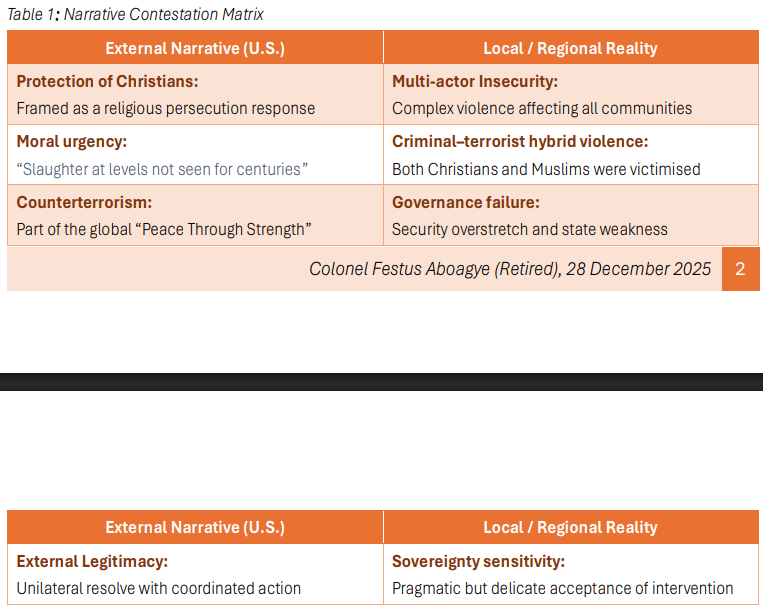
The religious framing by the U.S. risks inflaming sectarian tensions and providing extremist groups with
recruitment propaganda, while potentially obscuring the multifaceted nature of regional insecurity
Nigerian Domestic Calculations
President Tinubu faces mounting pressure to demonstrate security progress, with over 10,200 deaths from armed group attacks and 12,290 abductions generating ₦13 billion (about US$9 million) in ransom demands during his first two years. The deteriorating situation—which saw the North-Central zone overtake the Northeast as Nigeria’s new epicentre of violence and prompted a sweeping military reshuffle in October 2025—has severely tested his administration’s credibility on its core “Renewed Hope” security agenda.
Nigeria’s 3-Phase Drone/UAS Acquisition
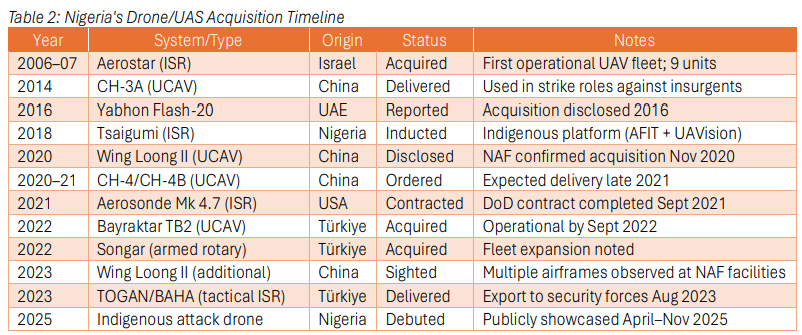
The strikes reflect pragmatic calculations about capability gaps despite modernisation efforts. Nigeria’s unmanned aerial capability has developed through three distinct phases (see Table 2 below). In Phase 1
(2014–2020), China anchored Nigeria’s entry into armed drones with the CH-3A (2014), later expanding
MALE and UCAV capacity through Wing Loong II and CH-4 systems, establishing persistent ISR and strike
capabilities for counter-insurgency operations. During phase 2 (2022–2023), Türkiye drove diversification
with Bayraktar TB2s and tactical systems (Songar, TOGAN, BAHA), creating a layered drone mix combining long-endurance strike platforms with flexible short-range assets. Phase 3 (2018–2025) saw the emergence of indigenous development with the Tsaigumi ISR drone (2018), culminating in the public debut of a locally produced attack drone (2025); these signalled ambitions to reduce external dependence.
Nigeria’s UAV Capability Mix
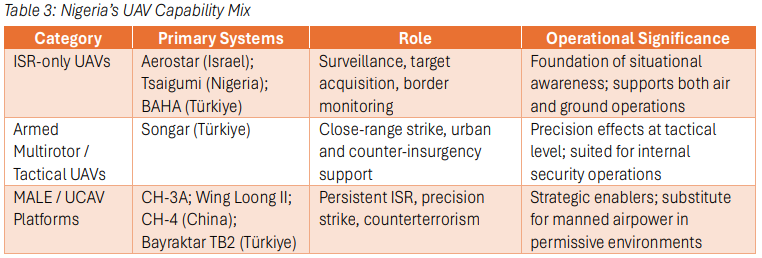
Despite this diversified acquisition timeline, Nigeria’s operational UAV ecosystem remains constrained by
strategic dependencies. Table 3 categorises Nigeria’s current unmanned capabilities by function, revealing
a capability structure heavily reliant on external suppliers despite indigenous development efforts. While Nigeria has acquired A-29 Super Tucanos (2021), Turkish (2022) and Chinese (since 2014) drones, and $346 million in U.S.-approved precision munitions, the Air Force Chief acknowledged that the U.S. provides only “what is adequate” rather than “the full extent of what the plane is capable of”. The Nigerian Air Force’s (NAF) emphasis on intelligence-driven precision strikes to avoid civilian casualties makes operations “very complicated and difficult”, requiring extensive surveillance and targeting circuits that limit operational tempo. For targets in Sokoto’s remote borderlands where ISSP operates covertly, limited precision-strike inventories and complex approval processes likely made U.S. intervention attractive despite sovereignty costs.
The “Targeting Circuit” Bottleneck: Why Nigeria Could Not Act Alone
NAF’s inability to neutralise the Sokoto targets independently, despite possessing an inventory of Chinese (CH-4) and Turkish Bayraktar (TB2) drones, reveals critical technological and intelligence bottlenecks. This deficit in precision airpower drives a profound asymmetric security dependency on the U.S. The “crucial question” of why Nigeria required U.S. kinetic intervention lies in three areas of efficacy:
1. Sensor Resolution and “Fused” Intelligence:
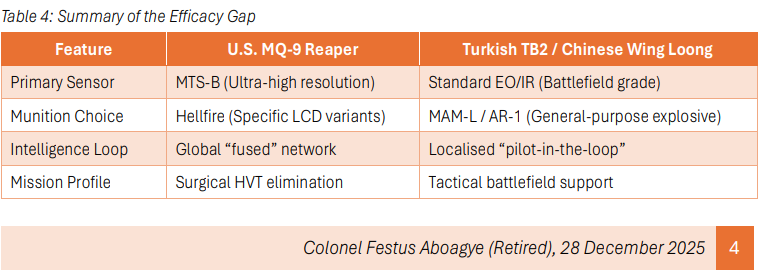
While Nigeria’s Turkish and Chinese platforms provide battlefield-grade electro-optical/infrared (EO/IR) imagery, they often lack the Multi-Spectral Targeting System (MTS-B) found on the U.S. MQ-9 Reaper. The MTS-B offers an “ID Card” resolution standard, capable of identifying high-value targets (HVTs) by facial features or specific clothing from extreme altitudes where the drone remains invisible. Furthermore, Nigeria’s “targeting circuit” for its existing fleet is essentially a “closed loop” where pilots rely on immediate visual feeds. In contrast, the U.S.
provides a “fused” intelligence architecture, where live drone data is analysed in real-time by a global network of specialists who cross-reference it with signals intelligence (SIGINT) to confirm identities in complex civilian environments.
2. Munition Precision–Hellfire vs. MAM-L: The choice of munition represents a vital sovereignty trade-off. The U.S. AGM-114 Hellfire—specifically its Low Collateral Damage (LCD) variants like the R9X—is engineered for “surgical” strikes with a highly focused blast radius. Conversely, the Chinese AR1 and Turkish MAM-L munitions in Nigeria’s arsenal are generally designed for open warfare with higher explosive yields. For the Sokoto strikes occurring near civilian clusters, the Nigerian government likely assessed that its own munitions carried an
unacceptable risk of “collateral tragedies,” similar to previous accidental NAF strikes.
3. The “Legal and Political” Shield: Beyond hardware, the use of U.S. platforms serves as an “Accountability Outsourcing” mechanism. By utilising U.S. targeting oversight, the Tinubu administration can claim that the operation met international “gold standards” for civilian protection, providing political insurance against the domestic fallout of a botched strike. As detailed in Table 4, this reliance is fundamentally a product of the efficacy gap between U.S. and regional systems, where the MQ-9 Reaper’s superior sensor resolution and surgical munition choices provide a level of precision currently unavailable to Nigeria’s indigenous or existing foreign
fleet.
Crucially, there is no public record of Nigeria previously requesting similar U.S. strikes, suggesting this departure
from precedent was driven by the escalating threat convergence detailed in Section III. The decision signals
that Tinubu’s administration prioritised immediate operational results over sovereignty optics, gambling
that successful strikes would bolster domestic security credibility more than nationalist objections eroding it.
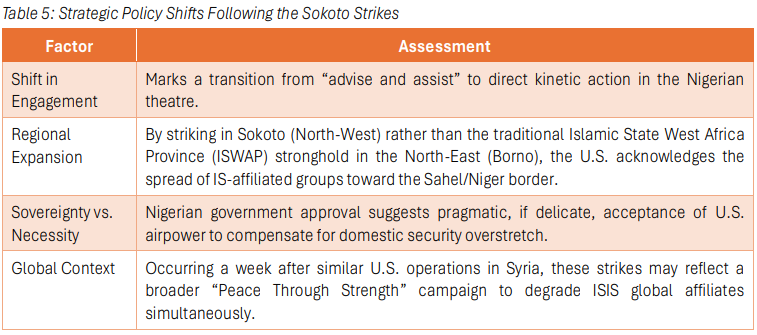
Ultimately, this technical reality transforms the “Targeting Circuit” into a tool of neocolonial dependency. While Nigeria owns the “wings” (the platforms) for 90% of its security needs, it remains strategically tethered to Washington for the “eyes” and “brains” (the sensors and fused data) required for the high-stakes 10% of missions where precision is the only safeguard for political survival. These competing narratives and domestic calculations reflect more profound strategic shifts in U.S.-Africa security relations that extend well beyond Nigeria’s immediate counterterrorism needs. The strategic shifts manifest most visibly in the U.S. military’s geographic repositioning across West Africa. Table 5 summarises the four critical dimensions of strategic transformation signalled by the Sokoto strikes:
VI. The New U.S. Military Footprint: From Centralised to Distributed
Strategic Rationale for Redistribution Following Niger’s July 2023 coup and the August 2024 forced withdrawal, the U.S. abandoned its centralised model—anchored by massive desert bases like Air Base 201—in favour of a distributed “light footprint” strategy across multiple coastal West African nations. This approach reduces vulnerability to single-country political upheaval, though it increases drone flight times to Sahel targets.
Current Operational Locations (Late 2025)
Personnel and heavy equipment from Niger’s former Air Base 101 and 201 were initially consolidated at
U.S. facilities in Germany and Italy before redistribution. By late 2025, U.S. counterterrorism operations span four main locations:
• Ghana: Primary operational hub, with intelligence flights and strikes launched from Accra’s Kotoka International Airport and potentially Tamale Air Force Base in the north.
• Benin: Forward surveillance site, where Washington invested $4 million to upgrade a northern airfield (near Parakou or Karimama) for reconnaissance missions, helicopter operations, and Special Forces border security training.
• Côte d’Ivoire: Strategic pivot point, with ongoing 2025 negotiations to establish drone deployments from existing military infrastructure in Abidjan and northwestern sites near Odienné, close to the Mali and Guinea borders.
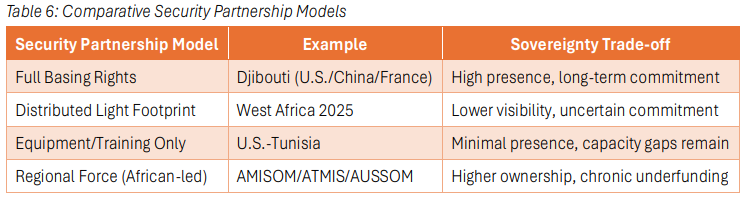
• Chad: Maintains northern surveillance capabilities through special operations forces who returned to ’Djamena in late 2024, following a brief earlier withdrawal. While this distributed model offers tactical flexibility, it introduces systemic risks that extend beyond immediate operational concerns. To contextualise this emerging architecture, Table 6 situates the U.S. distributed footprint within the broader spectrum of contemporary security partnership models operating.
VII. Risks and Implications
While this distributed architecture offers operational advantages in a politically unstable region, it generates four categories of risk that African policymakers and continental institutions must urgently address.
Extremist Recruitment and Propaganda
Foreign intervention, particularly when framed in religious terms, provides extremist groups with recruitment material to portray conflicts as a “Crusade” against Islam. ISSP and other terrorist networks in Nigeria, coastal Guinea countries, and the MENA region may escalate operations in response.
Sectarian Tensions
The U.S. emphasis on “protecting Christians” within the broader “global war on terror” narrative risks inflaming existing religious tensions within Nigeria’s diverse population and beyond, absent balanced local diplomacy.
Uncertain Long-Term Commitment
Defence Secretary Pete Hegseth’s “more to come” comment suggests sustained operations in Nigeria, coastal Guinea areas, and the Sahel. However, a critical dilemma persists: counterterrorism in a region that may not be a top U.S. strategic priority offers no guarantee of long-term engagement, potentially leaving African partners vulnerable to abandonment.
Asymmetric Security Dependencies
Recent West African developments carry a long-term risk of creating asymmetric security dependencies that erode strategic autonomy by outsourcing regional security to competing global powers pursuing strategic containment policies that may not align with African sovereignty and stability. It is permissible to conclude that, without a genuine partnership that respects African agency, these dynamics could lead to a long-term erosion of sovereignty. The danger is that the “regional security” narrative becomes a convenient vehicle for external powers to maintain a military presence that serves their geopolitical interests under the guise of collaborative security and humanitarian protection.
These risks—ranging from extremist recruitment to sovereignty erosion—are not hypothetical future
scenarios. They are already materialising in the immediate aftermath of the Sokoto strikes, demanding urgent strategic reflection on the path forward.
VIII. Conclusion
The Christmas Day 2025 airstrikes in Sokoto State mark a pivotal moment in U.S.-Africa security relations, signalling Washington’s transition from advisory support to direct kinetic intervention in Nigeria’s counterterrorism landscape. While operationally coordinated between both governments, the strikes reveal a troubling divergence in narrative framing: the U.S. administration’s emphasis on religious persecution conflicts with Nigeria’s understanding of the violence as a complex, multifaceted security crisis affecting communities across religious lines.
The shift to a distributed military footprint across Ghana, Benin, Côte d’Ivoire, and Chad demonstrates strategic adaptation following the Niger withdrawal. Yet it also represents a broader recalibration of Western engagement in the region. This decentralised approach, while reducing vulnerability to single country political instability, raises fundamental questions about sovereignty, sustained commitment, and the risk of inadvertently fuelling the very extremism it seeks to combat through religiously charged rhetoric that terrorist groups can exploit for
recruitment.
Most critically, these developments risk establishing a troubling precedent: the gradual outsourcing of
regional security to external powers pursuing containment strategies that may not align with Africa’s long-term stability interests. Without careful diplomatic management, balanced local engagement, and genuine partnership that respects African agency, current counterterrorism efforts could inadvertently serve neocolonial dynamics rather than sustainable peace. The international community must remain vigilant that the “regional security” narrative does not become a vehicle for undermining African sovereignty under the guise of protecting lives. This is the challenge for the African Union and African regional organisations.
Meeting this challenge requires moving beyond declaratory statements to concrete institutional mechanisms. The following policy recommendations provide an actionable framework for the AU Peace and Security Council to reassert continental agency in the face of externalised security interventions.
IX. Recommendations
To address the concerns of sovereignty, neocolonial dependency, and narrative imposition following the U.S. airstrikes in Nigeria, the AU must transition from reactive diplomacy to proactive institutional oversight.
The strategic landscape in late 2025 makes it imperative that the AU Peace and Security Council (PSC) consider the following policy recommendations.
1. Establish Continental Oversight of Foreign Kinetic Action: The AU should require that any foreign military strike on member-state territory—regardless of host-state consent—be formally notified to the AU PSC within 24-72 hours, supported by a standardised Post-Strike Accountability Brief covering civilian impact, intelligence justification, and legal basis under AU norms. The purpose is to prevent bilateral security arrangements from bypassing and undermining continental transparency and nonindifference principles. However, the AU will have no enforcement mechanism against major powers that
ignore this requirement.
2. Counter-Narrative Weaponisation through African Analysis: Mandate the African Centre for the Study and Research on Terrorism (ACSRT) to issue an independent Threat Context Report following any major external intervention in Africa. This will anchor counterterrorism narratives in African-led analysis and prevent the reduction of complex conflicts into
sectarian or ideological propaganda.
3. Regulate Distributed Foreign Military Footprints: Develop an AU Continental Drone and Surveillance Policy setting clear limits on the scope, duration, basing, and authorisation of foreign unmanned aerial vehicles (UAVs) and intelligence, surveillance and reconnaissance (ISR) operations on
African soil. The purpose is to prevent the gradual entrenchment of coastal states as permanent launch platforms for external military operations outside a collective AU strategy.
4. Reinvigorate the ASF for Sahelian Security: Fasttrack the reconceptualisation of the African Standby Force (ASF) to incorporate a counterterrorism capability, to close critical regional capability gaps
and reduce reliance on foreign airpower. After more than 20 years of chronic underfunding and lack of full
operationalisation, why would the ASF change now?
5. Mediate the AU–Sahel Divide: Convene a highlevel AU-led Sahel Reconciliation Dialogue to reengage the Alliance of Sahel States (AES) members within the continental security framework, decoupling security reintegration from immediate political conditionalities. The purpose is to close the geopolitical vacuum that enables external powers to exploit regional fragmentation. Given that AES states
have explicitly rejected AU mediation, it remains to be seen what leverage the AU has.
All said and done, it is worth acknowledging that while these obstacles are pertinent, they do not negate the recommendations’ validity.
References
Official Government & Military Statements
U.S. Africa Command (AFRICOM). (2025, December
25). U.S. Africa Command conducts strike against ISIS in Nigeria. [Press Release].
U.S. Department of War. (2025, December
25). Statement from Secretary Hegseth on precision strikes in Nigeria. [Official X/Social Media Communication].
U.S. Commission on International Religious Freedom
(USCIRF). (2025, November 3). Naming of Nigeria as a Country of Particular Concern is an important step to advance religious freedom. [Press
Release].
U.S. Department of Defence & Ministry of National
Defence of Niger. (2024, August 5). Joint statement on the completion of withdrawal of U.S. forces and assets from Air Base 201 in Agadez. https://www.war.gov/News/Releases/Rel
ease/Article/3861097/joint-statement-from-theus-department-of-defense-and-the-departmentof-nationa/
News & Investigative Reports
CBS News. (2025, December 26). U.S. launches strikes on ISIS targets in Nigeria on ChristmasDay, Trump says.
Business Insider Africa. (2025, May 18). U.S. moves closer to establishing its drone base in West African country.
Weiss, C. (2025, December 26). U.S. strikes Islamic State in Nigeria. FDD’s Long War Journal.
US strikes Islamic State in Nigeria
The Times of Israel. (2025, December 26). Trump says U.S. struck ISIS targets in Nigeria after group
targeted Christians.
Think Tank & Policy Analysis
Centre for Strategic and International Studies (CSIS). (2025, November 20). President Trump’s redesignation of Nigeria as a “Country of Particular Concern—CPC”: A serious, wellfounded wake-up call.
Thurston, A. (2024, January 10). Is that U.S. drone base in Niger really necessary? Responsible Statecraft.
Threat Assessment Sources
Armed Conflict Location & Event Data Project (ACLED). (2024). Political violence in the NigeriaNiger-Benin border region [Data file].
Barnett, J. (2024). Lakurawa and the Islamic State’s expansion in north-west Nigeria. Hudson Institute.
Mahmoud, Y. (2025). The Sahel-Nigeria conflict convergence: JNIM and ISSP in the tri-border region. African Arguments.
Pérouse de Montclos, M.-A. (2025). Islamic State expansion along the Niger-Nigeria border: From
banditry to jihadism. Institute for Security Studies.
Raineri, L., & Rossi, A. (2025). The governance dimensions of insurgency in north-west Nigeria. West Africa Report, 12(3), 45-67.
Zenn, J. (2024). Islamic State Sahel Province: Operational evolution and strategic objectives in West Africa. Jamestown Foundation Terrorism
Monitor, 22(24), 12-18.
Drone Capabilities & Ecosystems
Baykar Technologies. (n.d.). Bayraktar TB2 tactical UAS.
International Institute for Strategic Studies. (2023). The Military Balance 2023. Routledge.
Jane’s Defence Weekly. (2022). Nigeria expands UAV inventory with Turkish systems.
Military Africa. (2024). Nigeria’s drone inventory: From CH-3A to indigenous attack UAVs.
Textron Systems. (n.d.). Aerosonde UAS.
U.S. Department of Defence. (2021). Contract announcements: Aerosonde systems for partner nations
African Union Peace and Security Council. (2016, May 30). Communiqué of the 601st meeting of the PSC on the establishment of foreign military bases in Africa.
(PSC/PR/COMM.(DCI).
Baykar Technology. (2023). Bayraktar TB2 tactical UAS: Technical specifications.
Centre for Strategic and International Studies (CSIS). (2025, November 20). President Trump’s redesignation of Nigeria as a “Country of Particular Concern—CPC”: A serious, wellfounded wake-up call.
Defence Mirror. (2020, November 11).
General Atomics Aeronautical Systems. (2024). MQ9B SkyGuardian/SeaGuardian: The next generation of Remotely Piloted Aircraft Systems.
The Tricontinental: Institute for Social Research. (2021, July 6). Defending our sovereignty: U.S.
military bases in Africa and the future of African unity (Dossier No.42). https://thetricontinental.org/dossier-42-
militarisation-africa/
U.S. Department of State. (2025, October 30). 2025 Redesignation of Countries of Particular Concern
for religious freedom. [Official Statement].
U.S. Department of War. (2025, December
25). Statement from Secretary Hegseth on precision strikes in Nigeria. [Official Communication].
#Regional #security #brink #U.S #distributed #footprint #security #partnerships #sovereignty #tradeoffs #postNiger #West #Africa












Leave a Reply