
Three in four working Ghanaians do not believe they have saved enough for retirement, according to the 2025 Old Mutual Financial Wellness Monitor, with the proportion recording that lack of confidence rising for the third consecutive year despite a broader improvement in household financial sentiment.
The annual survey, now in its third year, covered 656 employed persons aged 20 to 59 earning a minimum of GH¢1,200 per month and is weighted to represent a 70:30 informal-to-formal sector split. Fieldwork was conducted in October 2025. The survey found that 74 percent of respondents lacked confidence in the adequacy of their retirement savings, up from 61 percent in 2024 and 56 percent in 2023. Only one in three said they had actively started saving for retirement.
The findings point to a widening gap between awareness and action. Ninety-two percent of respondents agreed that saving for retirement was important, up from 83 percent in 2024, yet retirement ranked seventh among stated savings goals, well behind emergency funds, children’s education, and business development.
Financial constraints were the most commonly cited barrier, with 32 percent of those not saving for retirement pointing to more pressing short-term demands on their income. A further 55 percent said they expected their children to support them financially in old age.
Distrust of formal financial institutions also featured prominently, with 53 percent of those not actively saving saying they feared losing their money if their pension provider collapsed; a reflection of the lingering impact of the 2017 to 2020 financial sector crisis and the Domestic Debt Exchange Programme, two years later, on household confidence in the formal savings system.
The retirement savings deficit cuts across income levels. Among respondents earning GH¢3,001 and above, the highest income band in the survey, 66 percent still lacked confidence in their retirement provision. The mean confidence score across all income bands was 4.9, less than half, on a ten-point scale. Only 13 percent of respondents said they used a financial adviser, while 47 percent reported being unsure where to turn for financial guidance. Those with financial advisers were significantly more investment-confident than those without.
Recovery, confidence
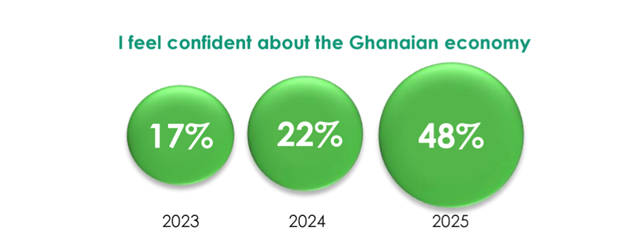
The retirement findings sit alongside a broader but uneven improvement in financial conditions. The proportion of working Ghanaians experiencing high or overwhelming financial stress fell from 60 percent in 2024 to 30 percent in 2025, the lowest level in the three-year series, while confidence in the economy rose from 17 percent in 2023, 22 percent to 48 percent over the same period. Thirty-seven percent of respondents reported earning more than a year ago, a 15-percentage-point increase since 2023.
Similarly, the size of the ‘sandwich generation’ — those with younger and older dependents — fell from 42 percent in 2023, 38 percent in 2024 to 31 percent in 2025.
Yet the survey surfaces significant fragility beneath the recovery as 53 percent of respondents said they would exhaust their funds within three months if they lost their income, and 39 percent remained worried about losing their job or income source despite the improvement in earnings. Investment confidence has declined, with those rating themselves very confident falling from 21 percent in 2024 to 14 percent in 2025.
Risk appetite has also compressed, with those willing to take substantial financial risk dropping from 24 percent in 2023 to 10 percent in 2025 — a trend the report attributes to economic scarring from the recent crisis period. Savings behaviour has improved in certain respects. Only 12 percent of respondents dipped into savings to make ends meet in the past year, down from 61 percent in 2023, and the proportion cashing in investments fell from 10 percent to 5 percent.
However, the savings architecture remains predominantly informal and short-term. Bank accounts are used by 57 percent of respondents for savings, mobile money by 50 percent, and susu participation has risen from 37 percent to 44 percent. Debt levels have also eased, with 67 percent reporting less debt than a year ago, assisted by a gradual reduction in borrowing costs during 2025.
Entrepreneurship remains a central feature of the working economy, with 41 percent of respondents owning or part-owning a business. However, 75 percent of those entrepreneurs operate in the informal sector, only 21 percent are formally registered, and just 6 percent access financing from formal financial institutions. Business insurance penetration stands at 16 percent.
Old Mutual’s response
Roy Punungwe, Group Chief Executive of Old Mutual Ghana, said the results confirmed that Ghana’s financial recovery was genuine, with much room for improvement.
“We are encouraged by what we are seeing. As macroeconomic conditions stabilise, working Ghanaians are responding with greater financial discipline, renewed optimism, and more intentional money behaviours. Stress levels are easing, incomes are improving for many, and households are beginning to move beyond survival toward recovery,” he said.
“While people are saving more and managing debt better, the data tells us clearly that most Ghanaians remain financially vulnerable. Savings are largely short-term and informal, retirement planning is still not a priority, and confidence in making long-term financial decisions continues to decline. Beneath the optimism sits a real risk: too many people would struggle financially if their income was disrupted, even briefly,” he added.
Mr. Punungwe said the findings pointed to a structural advice gap as much as a savings gap, arguing that Ghanaians were making rational decisions with the tools available to them but lacked access to trusted, long-term financial guidance.
He called on financial services institutions and policymakers to use the survey’s findings as a catalyst for broader engagement. “What this Monitor reinforces is that financial wellness is not only about getting through the next six months, it is about preparing for the next 20 to 30 years,” he said.
Old Mutual said it intended to use the findings to deepen its engagement with working Ghanaians on long-term financial planning, with a focus on rebuilding trust in formal savings and retirement products.
Overall financial wellbeing remains low, with 43 percent of respondents rating their wellbeing as poor on a ten-point scale and only 13 percent strongly agreeing that they had the financial freedom to enjoy their lives without undue financial pressure.
Read Original#Retirement #insecurity #deepens #among #workers #Mutual #survey
…WATCH THE VIDEO HERE





Leave a Reply